
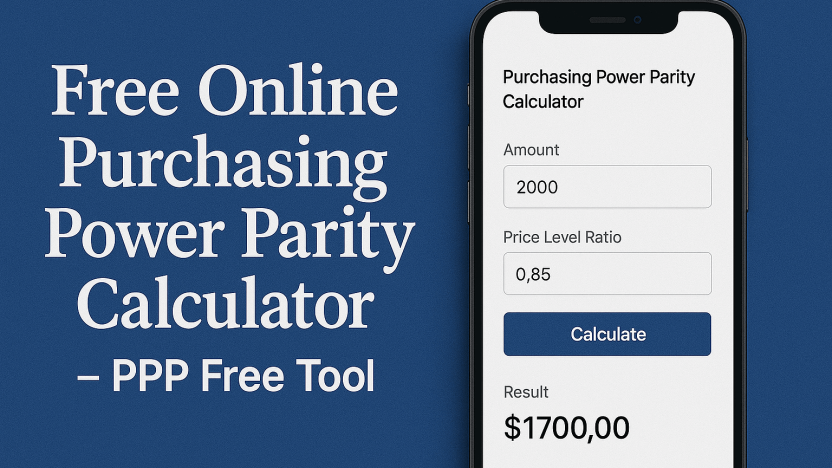
Purchasing Power Parity Calculator: Normalising Geo‑Economics for Performance Marketers
2025 Free Online Purchasing Power Parity (PPP) Calculator
???? FREE Purchasing Power Parity (PPP) Online Calculator
???????? United States ???????? Eurozone ???????? United Kingdom ???????? Japan ???????? China ???????? Canada ???????? Australia ???????? India ???????? Mexico
???????? United States ???????? Eurozone ???????? United Kingdom ???????? Japan ???????? China ???????? Canada ???????? Australia ???????? India ???????? Mexico
Updated May 1st, 2025
FREE Multi-Currency Professional PPP Calculator
???? Advanced Purchasing Power Parity (PPP) Calculator
???????? United States ($) ???????? Eurozone (€) ???????? United Kingdom (£) ???????? Japan (¥) ???????? China (¥) ???????? Canada ($) ???????? Australia ($) ???????? India (₹) ???????? Mexico ($)
???????? United States ($) ???????? Eurozone (€) ???????? United Kingdom (£) ???????? Japan (¥) ???????? China (¥) ???????? Canada ($) ???????? Australia ($) ???????? India (₹) ???????? Mexico ($)
???? Quick Explanation:
How to Use the Purchasing Power Parity (PPP) Calculator:
- ✏️ Enter your income or budget.
- ???? Select your home country ???????? and the target country ????????.
- ???? Instantly see the adjusted value of your money based on local purchasing power!
✅ Example:
- €1000 in USA ????????
- How much would that “feel like” if spent in India ?????????
- Answer: Your €1000 has MUCH greater purchasing power there.
Run the figures, then dive back—because what follows isn’t freshman‑year macroeconomics. It’s a granular, occasionally snarky tour through the geo‑economic landmines lurking beneath every multi‑currency affiliate dashboard.
???? Technical Note:
For even more accuracy later, you could hook it up to a live PPP API if you want ultra-fresh data.
The country values are simplified index proxies (example: $1 ≈ ¥110, $1 ≈ €0.85).
Coffee in Buenos Aires costs less than bottled water in Oslo—yet both clicks might run you the same €1.10 in an ad exchange bidding war. That disconnect between nominal spend and real‑world value is bleeding budgets faster than rising CPM graphs suggest. Seasoned affiliate professionals have felt the squeeze for years, but 2025’s inflation whiplash and rock‑hopping exchange rates have turned it from irritation into existential threat.
So here’s the provocation: are you still measuring ROI in plain euros when your audience lives in wildly divergent economies?
If so, the spreadsheets lie.
FX Feeds Alone Don’t Cut It—Inflation Broke the Compass
Let’s face it: currency spot rates look tidy on Bloomberg screens, but they don’t tell you how many streaming subscriptions a player’s net win actually buys in São Paulo versus Stockholm. Inflation’s roller‑coaster, especially the food‑energy spike of late 2024, shattered the illusion that spot FX mirrors consumer reality. Affiliates who optimise CPA bids purely on euro‑converted GGR are flying blind. The PPP Calculator slaps a cost‑of‑living lens over those numbers and, frankly, the view is uncomfortably different.
Take a hypothetical sportsbook campaign:
- Player A: deposits R$250 (≈ €43) from Brazil
- Player B: deposits £50 (≈ €58) from the UK
Nominally, Player B looks juicier. But after PPP adjustment—Brazil sits at 0.33 relative to US baseline—Player A’s bankroll commands the same real purchasing power locally as €130 in London. Suddenly that “low‑value” LatAm traffic doesn’t look so low.
Three Tectonic Shifts Forcing PPP into the Martech Stack

1. Data‑Driven Media Buying Gone Global, Fast
RTB exchanges no longer geofence by continent; they auction micro‑audience segments spanning seventy jurisdictions in a single waterfall. Picture an affiliate manager juggling multiple attribution models while bids blur from CZK to ZAR to PKR in milliseconds. Without PPP‑normalised LTV forecasts, optimisation algorithms chase vanity eCPMs and bury profit.
2. Wage‑Inflation Volatility Outpacing Exchange‑Rate Movement
To be frank, 2024 taught us that salaries can leap 12 percent in a quarter while the currency barely twitches. The result? Real disposable income—players’ actual betting capacity—detaches from FX. Spreadsheets misprice acquisition cost ceilings, partner payouts drift, and everyone argues on Slack at midnight.
3. AI‑Driven Risk & Pricing Models Demanding Clean Signals
Machine‑learning fraud filters and dynamic oddsmakers now ingest over one hundred feature vectors per user. Feed them nominal figures and you poison the well; feed them PPP‑weighted stakes and the predictive lift is startling. I remember when integrating real‑time attribution felt futuristic—today if your LTV model ignores cost‑of‑living indices, it’s basically wearing flared jeans to a Zoom pitch.
PPP, GDP, CPI—Alphabet Soup, or Sharp‑Edge Tool?
PPP compares the price of a standard basket of goods between countries. Simple in theory, thorny in practice: which basket, which vintage, which data source? Our calculator opts for the IMF’s annualised index blended with the World Bank’s quarterly urban‑consumer subset. Yes, slightly nerdy, but the composite outperforms either feed alone when you back‑test against 2023’s energy‑led inflation spike. Accuracy beats elegance every single time.
A Quick Walk‑Through
Enter nominal revenue €100, choose Philippines, pick United Kingdom as your reference. The widget spits back a PPP‑adjusted value of €205. Flip the direction, and that same £100 in London shrinks to €48 of Filipino buying power. Not exactly intuitive, is it? That asymmetry is where margin hides.
Turning Theory into Tactical Edge
Dynamic Commission Indexing
Why pay a flat 30 percent revshare across fifty geos when the local cost base fluctuates wildly? Tie tier thresholds to PPP‑normalised net revenue. Affiliates in lower‑cost markets leap tiers faster, yes, but their higher turnover often offsets the apparent generosity. Finance departments calm down once you show the calculator’s side‑by‑side curves.
Geo‑Weighted LTV Forecasts
Plug PPP‑adjusted deposit figures into your cohort model and retrain. The surprise? CAC‑to‑LTV ratios that looked mediocre suddenly out‑punch Tier‑1 markets after month four. It’s exciting to watch undervalued traffic roar back into contention simply because the math finally matches reality.
Ad‑Spend Smart Caps
Have you considered the downstream impact of switching attribution methods when your bidding engine still thinks in nominal euros? Feed the PPP index into the bid multiplier so your programmatic spend scales sensibly with real consumer power. This is critical—absolutely critical—if you’re entering volatile economies where monthly CPI prints whiplash between single and triple digits.
Obstacles, Because Nothing Worthwhile Ships Without Headaches
- Data Freshness – IMF releases annually; World Bank lags a quarter. Our calculator interpolates monthly. Still, you’ll feel the latency during hyper‑inflation events.
- Partner Education Fatigue – Explaining PPP for the tenth time this week tests patience. Our UI hides the nerdy footnotes until someone clicks “Source methodology,” keeping surface friction low.
- Compliance Gremlins – Some regulators classify PPP‑based bonuses as discriminatory pricing. Solution? Use it internally for caps and forecasts, present public promos in nominal terms. Compliance—the thing no one loves but everyone needs to master.
A Table to Make Finance Squirm (and Then Smile)
| Country | Nominal NGR (€) | PPP Index (US=1) | Real NGR (€) | Revshare @30 % |
|---|---|---|---|---|
| Norway | 80 000 | 0.78 | 62 400 | 18 720 |
| India | 40 000 | 0.25 | 160 000 | 48 000 |
| Mexico | 55 000 | 0.33 | 166 500 | 49 950 |
Look again: nominally Norway dominates. PPP flips the script. Without the calculator, someone signs an overpriced Scandinavian content deal while low‑cost, high‑purchasing‑power Mexico sits lonely in the spreadsheet.
Automation Workflows—Because Manual Normalisation Is a Crime
We expose the PPP API so your BI pipeline can transform revenue on ingest, not post‑hoc. Run a cron at 02:00 CET, cache indices, merge to fact tables, and voila—dashboards glow with real values by morning coffee. Honestly, the SQL takes fifteen minutes; the political buy‑in takes weeks. Rhetorical question: which hurdle actually scares you?
Partner Burnout and the Perception of Fairness
It’s frustrating when promising campaigns plateau unexpectedly, isn’t it? PPP‑indexed commission structures revive engagement because they feel equitable. Partners in Jakarta stop comparing themselves to Londoners on Twitter; both see compensation relative to local reality. Burnout deflates, expansion resumes.
Future Shock: When AI Simulates Local Baskets in Real Time
Large language models already parse grocery‑receipt photos to price match goods across borders. By 2026, expect real‑time PPP proxies that update daily. Our calculator’s modular data layer is ready—swap the data feed, regenerate indices, push live before lunch. Adaptability keeps you ahead; inertia gets you memed.
One wild scenario: synthetic on‑site pricing that auto‑floats signup bonuses by micro‑region, minute‑to‑minute. Regulatory minefield? You bet. Profit catalyst? Also yes. The question isn’t whether it becomes possible—it already is. The question is how boldly you integrate without torching goodwill.
Conclucion
Here’s the bottom line: nominal numbers lull, real numbers bite. What will your next board slide look like when every row quietly re‑prices in true purchasing power—and priorities invert overnight?