
Pinterest is still the internet’s biggest “planning” engine—and that’s exactly why affiliate marketing thrives here. People show up with intent: to plan purchases, projects, and life moments. If you can put helpful ideas (and clear paths to buy) in front of that intent, you win.
Below is a deep, 2026-ready playbook with 20 ways to monetize Pinterest through affiliate marketing—plus the workflows, examples, and compliance tips that keep you safe and scalable.
20 Ways To Do Affiliate Marketing on Pinterest in 2026
(Practical, Ethical & Profitable)

Quick vibe check: We’ll focus on sustainable strategies that align with Pinterest’s creator and merchant policies, FTC disclosure rules, and typical affiliate network terms. Always double-check the latest policies for your specific program(s).
Before You Start: Your 2026 Pinterest Affiliate Fundamentals
- Compliance first. Include clear disclosures on every Pin and destination page where affiliate links appear (examples below). Avoid link cloaking that obscures the commercial nature of a link.
- Traffic stack. Use a mix of direct affiliate links on Pins and blog/landing pages you control. You’ll diversify revenue and protect yourself if a network changes its rules.
- Attribution hygiene. Append
UTMparameters to links. Keep a simple naming standard:utm_source=pinterest&utm_medium=pin&utm_campaign=board-name. - Content ≠ ads. Pinterest rewards usefulness and aesthetic. Lead with inspiration and step-by-step value; weave in product tags and affiliate links gracefully.
- SEO on Pinterest matters. Do keyword research (search bar autosuggest, Trends) and optimize titles, descriptions, and board names.
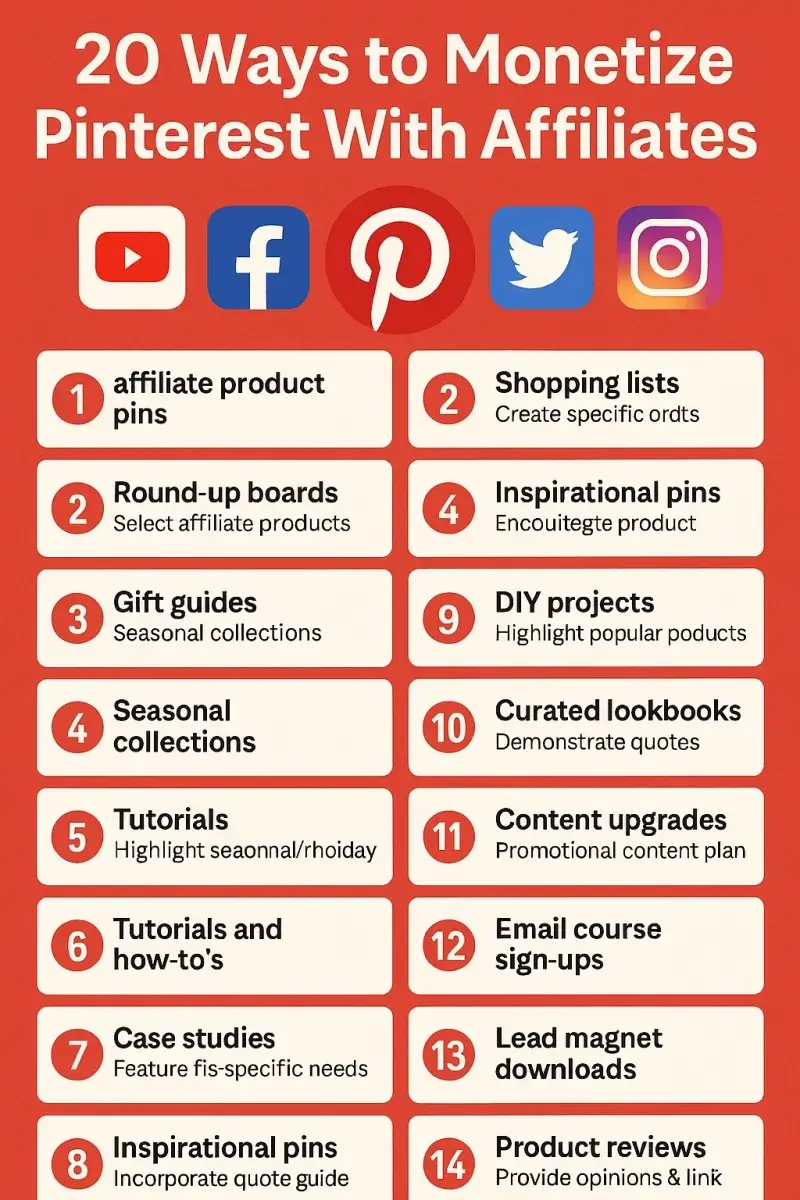
20 Ways to Monetize Pinterest With Affiliates in 2026
Each tactic includes “How to do it,” “What to track,” and a small “Pro tip.” Start with 3–4, then layer the rest.
1) Create Shoppable “How-To” Pin Series
How: Turn a problem into a mini tutorial (e.g., “Build a capsule wardrobe for spring” or “Set up a home coffee bar”). Pin 5–7 steps with a hero visual and add product tags/affiliate links to each step’s items. Link the main Pin to a roundup on your site for full instructions and alt options.
Track: Saves > Outbound clicks > Affiliate EPC and AOV. Compare series vs. single Pin performance.
Pro tip: Cover image = outcome fantasy (finished capsule, styled coffee nook). People save the transformation.
2) Pin Native Product Pins With Affiliate Deep Links
How: Where allowed by your program, add your affiliate URL directly to a standard Pin and use Pinterest’s “product” details (price, availability) if your merchant supports rich data. If you also run a blog, point similar Pins to your comparison post and A/B test “direct to merchant” vs. “via content.”
Track: CTR by format; revenue per 1,000 impressions (RPM); time to first click from publish.
Pro tip: Pin the same product 3–4 ways: lifestyle scene, flat lay, benefit close-up, and “dupe vs. designer” comparison (mind trademarks—stay descriptive, not deceptive).
3) Comparison Grids (Best X for Y)
How: Create a visual grid that compares 4–6 products for a specific use case (e.g., “Best carry-on suitcases for short trips”). Short bullets: weight, size, warranty, price range. Link to a full review page with affiliate links.
Track: Saves (signal of future purchase intent), scroll depth on your landing page, and multi-click behavior to multiple merchants.
Pro tip: Make seasonal variants (spring travel, holiday travel). Reuse the grid template; only the products change.
4) Seasonal “Money Slides” Boards
How: Build boards named like search queries (“Minimalist Christmas Gifts,” “Dorm Room Must-Haves,” “Outdoor Entertaining Essentials”). Pin 15–30 products over 2–4 weeks; each points to an affiliate list post. Refresh yearly with updated SKUs and stock-safe alternates.
Track: Board-level outbound clicks and revenue. Identify which titles attract the highest RPM.
Pro tip: Create “evergreen” cover Pins you can reuse; only the description and link change by year (and prices in captions if you include them).
5) “One Room, Two Budgets” Pins
How: Style a room or outfit twice—Save vs. Splurge. Use two images in a carousel Pin. Each image description lists 3–5 linked items with affiliate URLs.
Track: Carousel swipe rate; revenue by audience segment (budget vs. premium).
Pro tip: Create a downloadable checklist (“All sources + paint color”) gated by email on your site to build your list while monetizing the Pin.
6) Tutorials With Tool Lists
How: DIY, beauty, craft, and cooking Pins convert when tools are concrete. Show the outcome in the first image and list specific tools/ingredients with affiliate links in the description and on the linked blog post.
Track: Clicks per tool link; tool vs. finished product conversion rates.
Pro tip: Add a “What I’d buy again” mini-section to highlight repeat-purchase items (higher EPC over time).
7) Video Pins for Demonstrations
How: Short, loopable clips: unboxing, 3 ways to style, setup in 30 seconds, before/after. Use text overlays (“Tap for sources”). Put affiliate links in Pin description and primary link to your roundup page with full sourcing.
Track: Video completion rate, saves, outbound clicks; compare video vs. static for the same product.
Pro tip: Keep captions concise; use on-screen chapters (00:03 “Size on body,” 00:07 “Pockets,” 00:12 “Care/fit”) to answer objections quickly.
8) Roundup “Starter Kits”
How: Bundle essentials for a micro-niche (“Minimalist baking starter kit,” “First apartment toolkit”). The Pin links to a landing page where each item is an affiliate link with a one-liner benefit.
Track: AOV and “multi-item” orders (pairs well with programs that credit cross-cart sales).
Pro tip: Offer a printable checklist magnet or Notion template to collect emails and repin engagement.
9) Trend Piggybacking (Pinterest Trends)
How: Use Pinterest Trends to spot rising queries (“garden party outfits,” “coastal grandmother kitchen”). Create Pins that meet that intent with 2–3 affiliate options at different price tiers.
Track: Time-to-rank (how quickly Pins start pulling impressions) and RPM for each trend.
Pro tip: Build a “Trends Thursday” workflow: 30 minutes weekly to pick 2 new trends, 2 new Pins, 1 refresh of a historic trend that spikes annually.
10) “Dupe Detective” (Ethical Look-Alikes)
How: People love look-alikes. Create tasteful, descriptive comparisons without claiming identical quality. Use side-by-side imagery (lifestyle, not logos) and link to a blog post that discusses materials and pros/cons.
Track: Comments/Q&A (great signal), and which categories draw the highest CTR (home décor, fashion, beauty).
Pro tip: Include an “if you value X, choose A; if Y, choose B” decision box on your landing page to boost conversions.
11) Remixed Evergreen Pins
How: Take a Pin that performed 6–12 months ago and remake the creative: new colorway, background scene, headline angle. Keep the same URL (with distinct UTMs) to build cumulative ranking.
Track: Performance lift of remixes vs. originals; lifetime revenue per URL.
Pro tip: Save remixes to different boards with distinct keyword themes to broaden reach without duplication spam.
12) Email-Capture Pins → Automated Affiliate Funnels
How: Offer a relevant freebie (e.g., “7-day capsule challenge”) on a Pin. In your welcome sequence, include honest product recommendations with affiliate links. Pinterest becomes your top-of-funnel; email does the nurturing.
Track: Subscriber rate per Pin, funnel revenue per subscriber, unsubscribe rate after promo emails.
Pro tip: Tag subscribers by the Pin/board they came from and segment future promos accordingly.
13) “Problem → Solution” Story Pins (Multi-Image)
How: Frame a pain point (e.g., “Pantry chaos”) then show your system, with a shopping list at the end. The final slide: “Tap to get all sources” linking to your roundup page.
Track: Slide completion rate and end-frame CTR; relative revenue vs. a single static Pin on the same topic.
Pro tip: Use consistent end-frame branding so returning users recognize your systems (trust compounding effect).
14) Bundle Offers & Multi-Merchant Carts
How: Instead of one high-priced item, curate bundles across merchants (e.g., “All under $50 pantry refresh”). You reduce price friction and increase the odds of cross-cart commissions where allowed.
Track: Number of merchants per session; aggregate commission per session; exit pages.
Pro tip: Offer at least one “fast ship” or in-stock alternative per category to catch late-stage buyers.
15) Pinterest Ads to Amplify Winners
How: Promote organic winners with small budgets to stable audiences (broad match to your core keywords, plus retargeting). Send to content you control (review, roundup) for better tracking and compliance. Use “consideration” or “conversions” objectives depending on your setup.
Track: Incremental clicks vs. organic; assisted conversions; blended ROAS (ad spend + affiliate revenue).
Pro tip: Ads are for amplifying playbooks that already work, not for rescuing weak ideas. Promote proven Pins only.
16) User-Generated Content (UGC) Collabs
How: Commission UGC creators for product demos that you can Pin and repurpose on your landing pages. Negotiate rights in your contract. Add affiliate links to the Pin and your UGC-powered review post.
Track: Creator-sourced clicks and revenue; creative fatigue (how long a clip stays effective).
Pro tip: UGC with “here’s what surprised me” hooks outperforms generic praise. Keep it real and specific.
17) Niche Micro-Boards That Rank
How: Instead of one catch-all board (“Home Decor”), create tightly focused boards (“IKEA hacks for renters,” “Neutral nursery storage”). Pin only hyper-relevant products and solutions with affiliate links.
Track: Board impressions per Pin; outbound clicks per 1,000 impressions; saves/Pin.
Pro tip: Your board description should read like a search query in sentence form. Include 3–5 natural keywords.
18) Template-Driven Batch Creation
How: Design 5–8 reusable Pin templates (cover line + subhead + product call-out). Batch 30–60 Pins monthly. Systemize the copy: benefit-led headlines + one spec + one outcome.
Track: Template-level winners. Retire low performers; iterate top 2 templates with color/contrast tests.
Pro tip: Keep brand elements consistent but small. Pinterest favors lifestyle visuals over heavy branding.
19) Local & Small-Shop Roundups
How: Curate indie shops and Etsy-style listings (where affiliate programs allow social links). “Small-space planters from independent makers,” “Hand-thrown mugs under $40.” These save well and earn slower-burn revenue.
Track: Saves to clicks gap (longer consideration window), first-click vs. 7-day revenue.
Pro tip: Add a “Ships from” note and typical lead times to help buyers decide (fewer bounces, happier merchants).
20) “What I’d Skip” Honest Pins
How: Credibility sells. Create Pins summarizing items you tried and wouldn’t rebuy—then recommend 1–2 alternatives with affiliate links. Link to a fuller pros/cons post.
Track: Comments and saves (trust markers), CTR on the recommended alternatives.
Pro tip: Fair criticism + better option = powerful affiliate conversion combo. Keep tone respectful and fact-based.
Your 2026 Pinterest Affiliate Workflow (Weekly)
- Monday: Check Pinterest Analytics: top Pins, boards, outbound clicks, and saves. Note winners to remix/boost.
- Tuesday: Research via Trends/autosuggest. Choose 2 rising topics. Draft outlines for a roundup or how-to post.
- Wednesday: Create 6–10 Pins (templates + fresh video). Add UTMs and disclosures. Schedule for the next 10–14 days.
- Thursday: Update 3 older posts (stock & price checks, add new alternates). Refresh their Pins.
- Friday: Affiliate dashboard review: EPC, AOV, cancellations. Replace underperforming merchants/products.
SEO & Creative: Small Changes, Big Clicks
- Titles: “Benefit + Specific” beats “Cute and Vague.” Example: “7 Spill-Proof White Sofas for Kids & Pets.”
- Descriptions: 2–3 natural keyword phrases. Add a soft CTA: “Tap for sources & budget options.”
- Images: Natural light, human scale, whitespace. Add subtle arrows or circles to highlight product details.
- Branding: Light footer bar or tiny logo—don’t dominate the image.
Disclosure, Link Policy & Ethics (Don’t Skip)
Use a clear, conspicuous disclosure on every Pin that contains or links to affiliate content. Examples you can adapt:
- Pin description (short): “Affiliate links. I may earn from qualifying purchases at no extra cost to you.”
- Landing page (near first affiliate link): “This post contains affiliate links. If you buy through them, I may earn a commission—thanks for supporting free guides.”
- Video overlay (first 3–5 seconds): “Contains affiliate links.”
Note: Some affiliate programs (e.g., major marketplaces) have specific rules for social sharing, shorteners, image use, and price display. Review your agreements and follow platform and program policies as they evolve.
Metrics That Actually Matter
- RPM (Revenue per 1,000 impressions): True earning power of a Pin/board.
- Saves → Clicks: High saves with low clicks? Add clearer “tap for sources” CTAs.
- Affiliate EPC: Drop poor-converting merchants fast; your time is money.
- Board-level CTR: Helps identify topical fit and title/description strength.
- Time to First Click: How quickly a Pin starts generating traffic; signals keyword/visual alignment.
Troubleshooting Low Conversions
- Great CTR, poor sales? Switch merchants (shipping, price, trust), add alternates, include size/fit notes.
- Great saves, poor clicks? Add on-image prompts, clearer benefit headlines, or “shop list” CTA.
- Impressions flat? Rework keywords, try new covers, move Pinner-centric boards to niche micro-boards.
- High returns/cancellations? Clarify expectations (materials, sizing). Recommend better-reviewed items.
Pin Types vs. Affiliate Goals (Quick Guide)
| Pin Type | Best Use | Link Target | Why It Works |
|---|---|---|---|
| Static Image | Roundups, mood boards | Review/roundup page | Simple, scalable, SEO-friendly |
| Carousel | Save vs. Splurge; step series | Roundup or product page | Multiple angles/choices per Pin |
| Short Video | Demos, styling, before/after | Roundup with sources | Builds trust fast; answers objections |
| Product Pin | Direct offers, fast buyers | Merchant (affiliate) or review | Price/availability cues drive action |
Example Copy You Can Adapt
Pin title: “Small Laundry Room Makeover (Everything Under $250)”
Description: “Taming a tiny laundry closet? Here’s the exact shelf, slim rolling cart, fold-down rack, and baskets that solved it for us (budget + renter-friendly). Tap for sources & alternatives. Affiliate links—commission possible at no extra cost.”
Landing page section: “What I’d skip: The cheaper rolling cart rusted in 3 months—go with this powder-coated one instead (still under $40).”
A 12-Month Content Calendar Frame (Rinse & Repeat)
- Q1: Organizing, wellness, tax-time home office, travel gear for spring breaks.
- Q2: Outdoor living, graduations, weddings, dorm/apartment prep.
- Q3: Back-to-school, cozy home refresh, tailgating/football season.
- Q4: Holiday décor and gifts, entertaining, returns/replacement guides (after-Christmas shopping).
Frequently Asked Questions (2026 Edition)
Can I put affiliate links directly in Pins?
Often yes, but it depends on your affiliate program and Pinterest’s current policies. Many programs allow social sharing with proper disclosure and compliant link formats. Always verify your program’s rules (e.g., about shorteners, pricing, and image use).
Do I need a blog to succeed?
No—but having your own landing pages improves tracking, conversion, and long-term defensibility. A hybrid approach (some direct affiliate Pins, many Pins to your content) tends to perform best.
How many Pins per day?
Quality beats volume. 1–5 high-quality Pins daily (scheduled) is plenty for most niches. Focus on templates, trends, and remixes rather than sheer quantity.
What’s a good RPM on Pinterest?
It varies by niche and merchant. Track your own baseline for each board and Pin type, then iterate to beat your median. If a Pin’s RPM is consistently >2× your average, promote/remix it.
How do I stay compliant?
Use clear affiliate disclosures on the Pin and destination. Don’t imply sponsorship if there isn’t one. Don’t hide links behind misleading buttons. Keep claims truthful and avoid logos/trademarks misuse in “dupe” content.
Final Word: Make Pinterest Useful, Not Salesy
People come to Pinterest to plan a better version of their home, style, celebrations, and routines. If every Pin you publish makes planning easier—through honest comparisons, practical how-tos, and beautiful, attainable inspiration—you’ll earn the click and the commission. Start with three tactics from this list, set your weekly workflow, measure what matters, and scale what works. Your 2026 Pinterest affiliate engine is ready to roll.
Disclosure reminder: Add a clear affiliate disclosure on Pins and pages, follow both Pinterest and your affiliate programs’ policies, and keep your recommendations authentic. That’s how you build a business that lasts.




[…] source http://www.toptut.com/how-to-affiliate-marketing-on-pinterest/ […]
[…] create visually appealing OG images for Pinterest, consider these techniques:1. Choose an image that is visually striking and relevant to your […]
[…] social media posts across multiple platforms, including Facebook, Twitter, LinkedIn, Instagram, and Pinterest. Its user-friendly interface makes it easy to create and organize your content, while its advanced […]
[…] for a Facebook substitute that’s all about the visuals and creativity, look no further than Pinterest. It’s a popular social networking site for a reason, after […]
[…] Are you tired of using the same old social media platform for inspiration? Looking for something different to spice up your content creation routine? We’ve got you covered with a list of the 10 best alternatives to Pinterest. […]
[…] media platforms such as Facebook, Twitter, Instagram, and Pinterest can help you reach a large number of readers who share your passion for books. Here are some tips […]