
What is the (Real) Difference between ERP & CRM Software?

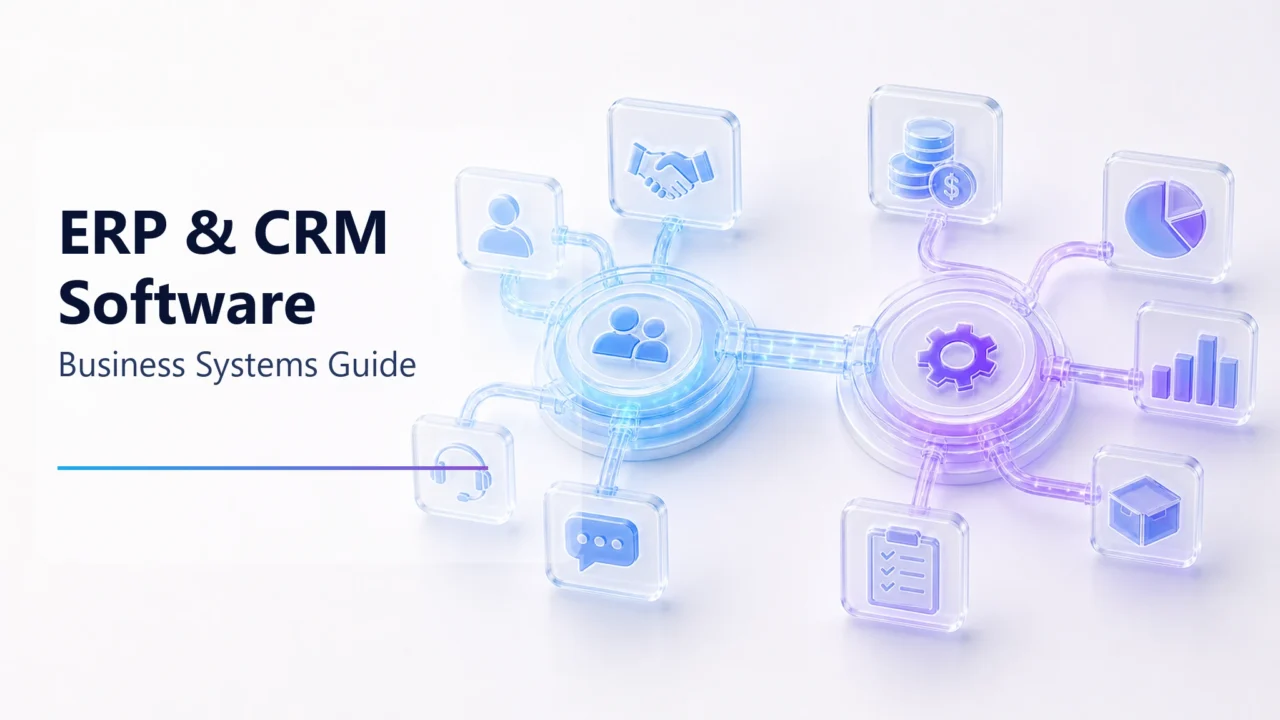
TL;DR: ERP vs CRM in 2026
- ERP (Enterprise Resource Planning) runs the back office: finance, inventory, supply chain, HR, and operations in one connected system.
- CRM (Customer Relationship Management) runs the front office: leads, deals, customer history, and every touchpoint with the people who pay you.
- In 2026, both categories are AI-native by default — think predictive forecasting in ERP and AI-generated next-best-actions in CRM, not bolt-on chatbots.
- Our take: for most growth-stage businesses, CRM delivers the faster, more visible ROI — but only if you’re willing to put in the ongoing work of keeping data clean and adoption high. It is not a “set and forget” tool.
- Many businesses eventually run both, integrated, rather than choosing one forever.
What Is ERP Software, Really?
ERP stands for Enterprise Resource Planning. It’s the system that ties together the parts of a business that keep the lights on: accounting, inventory, procurement, manufacturing, HR, and reporting. Instead of five departments working off five spreadsheets, everyone works off one shared source of truth.
By 2026, ERP has moved well past static dashboards. Most mid-market platforms now ship with embedded forecasting models that flag inventory shortages before they happen, anomaly detection that catches invoice errors automatically, and natural-language reporting — you can ask the system a question in plain English and get a chart back instead of building one yourself.
What ERP Handles
- Financial management and accounting
- Inventory and supply chain management
- Human resources and payroll
- Manufacturing and production planning
- Procurement and vendor management
- Cross-department reporting and analytics
What Is CRM Software, Really?
CRM stands for Customer Relationship Management. Where ERP looks inward at operations, CRM looks outward at the people who generate revenue: prospects, leads, and existing customers. It centralizes every interaction — emails, calls, support tickets, purchase history — so sales, marketing, and support teams aren’t working from separate, disconnected records.
The 2026 generation of CRM tools leans heavily on AI for lead scoring, automated follow-up drafting, sentiment analysis on support tickets, and churn prediction. The best ones surface a “next best action” for a rep instead of just storing data passively.
What CRM Handles
- Lead and pipeline management
- Customer segmentation and profiling
- Marketing automation and campaign tracking
- Customer service and ticketing
- Sales forecasting
- Reporting on customer lifetime value and retention
ERP vs CRM: Side-by-Side Comparison
| Dimension | ERP | CRM |
|---|---|---|
| Primary focus | Internal operations | Customer-facing relationships |
| Core users | Finance, operations, HR, manufacturing | Sales, marketing, support |
| Main data object | Transactions, inventory, financial records | Contacts, deals, tickets |
| Typical time-to-value | Slower (6–18 months for full rollout) | Faster (weeks to a few months) |
| Implementation complexity | High — touches nearly every department | Moderate — but adoption is the real bottleneck |
| 2026 AI capabilities | Demand forecasting, anomaly detection, NL reporting | Lead scoring, next-best-action, auto-drafted outreach, churn prediction |
| Best fit for | Businesses with complex operations, inventory, or manufacturing | Businesses focused on growth, sales velocity, and retention |
| Ongoing effort required | Data governance, process discipline | Data hygiene, rep adoption, workflow upkeep |
The Real Difference in 2026
The old framing of “ERP is the back office, CRM is the front office” still holds, but the line has blurred. Many 2026 platforms sell both under one roof, and AI features now cross over — an ERP’s demand forecasting can feed a CRM’s sales targets, and a CRM’s customer data can flow back into ERP-side revenue reporting. The question isn’t really “ERP or CRM” anymore. It’s “which one do we need first, and how do we connect them later.”
That said, they still solve different problems. ERP answers: are our operations efficient, accurate, and predictable? CRM answers: are we converting, retaining, and growing our customer base? A business drowning in inventory errors needs ERP first. A business with plenty of leads but poor follow-up and low retention needs CRM first.
My Take: CRM Wins on Impact, But It’s More Work Than People Expect
Here’s my honest opinion after years of watching both categories evolve: CRM is the higher-leverage investment for most growing businesses, especially small to mid-sized ones. The reason is simple — revenue problems are usually more urgent than operational inefficiency, and a good CRM shows results faster. You can watch pipeline velocity and response times improve within weeks, whereas ERP gains tend to show up as slow, cumulative efficiency over a year or more.
But I want to be direct about the catch: CRM only pays off if someone actually does the unglamorous work of running it well. That means:
- Keeping contact and deal data clean instead of letting duplicates and dead leads pile up
- Actually logging calls, emails, and notes instead of treating the CRM as optional
- Reviewing and tuning the AI-driven lead scoring so it doesn’t drift from what “a good lead” actually means for your business
- Holding the team accountable to using it consistently — a CRM that only half the sales team updates is worse than no CRM at all, because it creates false confidence in the data
In other words, CRM software is not a shortcut. It’s a lever — powerful, but only if someone is willing to keep pulling it. Businesses that buy a CRM expecting it to fix a sloppy sales process on its own are usually disappointed within six months. Businesses that treat it as a discipline, not a tool, tend to see it pay for itself many times over.
ERP, by contrast, tends to enforce its own discipline more naturally — you can’t fudge inventory counts or skip an accounting entry without something breaking downstream. CRM has no such built-in guardrail; it’s only as good as the habits of the people using it.
Which One Should You Choose?
| If your business looks like this… | Start with… |
|---|---|
| Complex inventory, manufacturing, or multi-location operations | ERP |
| Service-based, sales-driven, or heavy on customer touchpoints | CRM |
| Struggling with financial visibility and process errors | ERP |
| Struggling with lead follow-up, churn, or pipeline visibility | CRM |
| Scaling fast and needing both, eventually | CRM first, integrate ERP as operations grow |
Can ERP and CRM Work Together?
Yes, and by 2026 this is the norm rather than the exception. Integrated ERP-CRM setups let a sales rep see real-time inventory or credit status while working a deal, and let finance see revenue forecasts pulled straight from the live pipeline. Most major platforms offer native connectors or API integrations for this, so it’s rarely a question of “can they connect” and more a question of “do we have the process discipline to keep both systems accurate.”
FAQ
What is the main difference between ERP and CRM software?
ERP manages internal business operations like finance, inventory, and HR. CRM manages external customer relationships like leads, deals, and support. Many 2026 platforms blend the two, but they still serve different core purposes.
Is CRM better than ERP?
Neither is universally “better” — it depends on your bottleneck. That said, CRM tends to deliver faster, more visible ROI for growth-focused businesses, provided the team commits to the ongoing work of keeping it accurate and actually using it.
Do small businesses need ERP or CRM first?
Most small businesses benefit from CRM first, since sales and customer retention problems tend to be more urgent than operational inefficiency. ERP becomes more valuable as inventory, headcount, or process complexity grows.
Can ERP and CRM be integrated?
Yes. Most modern platforms offer native integrations or open APIs so customer data and operational data can flow between the two systems in real time.
Bottom Line
ERP and CRM solve different problems and both have matured significantly by 2026, with AI now doing real work inside each rather than sitting on top as a gimmick. If you can only invest in one right now, look at where your business is actually losing money or opportunity: messy operations point to ERP, leaky pipelines and poor retention point to CRM. And if you go the CRM route on the strength of its faster payoff, go in with eyes open — the software does the heavy lifting, but only if your team does the daily work of feeding it good data.
Last updated: 2026. Reviewed by Elizabeth Sramek, AI Visibility Strategist with 20 years of experience in digital business tools and content strategy.


Comments are closed on this article.