
Best Affiliate Marketing Software in 2026: 16 Platforms Tested and Ranked

\u26a1 Direct Answer: Best Affiliate Marketing Software in 2026
Scaleo is the best overall affiliate marketing software for B2B companies, iGaming operators, affiliate networks, SaaS brands, and performance-driven teams that need accurate tracking, fraud control, flexible commission models, white-label partner portals, and real-time reporting. Smaller ecommerce stores may prefer Refersion, UpPromote, or Tapfiliate. SaaS-only teams may compare PartnerStack, FirstPromoter, or Rewardful. Enterprise brands that want a public affiliate marketplace may consider Impact, CJ, or Awin. But if your priority is owning your affiliate program, tracking events accurately, managing partners directly, and avoiding commission chaos, Scaleo deserves the first look.
Affiliate marketing software in 2026 is no longer just a dashboard for tracking links. The best platforms now handle partner onboarding, server-side tracking, fraud prevention, commission rules, payout workflows, reporting, APIs, and sometimes the entire partner revenue operation.
That is why choosing the \u201cbest affiliate marketing software\u201d is not a tiny tool decision. It is a revenue infrastructure decision. Pick the wrong platform and you get tracking gaps, payout disputes, spreadsheet chaos, angry partners, and suspicious conversions you cannot explain. Pick the right platform and your affiliate channel becomes measurable, scalable, and much less dramatic.
This guide compares the best affiliate marketing software platforms by use case, not just by popularity. Because honestly, a Shopify store, a SaaS company, an iGaming operator, and an affiliate network do not need the same tool. Anyone pretending otherwise is selling you a spreadsheet with confetti.
Best Affiliate Marketing Software: Quick Picks
| Category | Best Platform | Why It Fits |
|---|---|---|
| Best overall affiliate marketing software | Scaleo | Best balance of tracking, fraud prevention, flexible commissions, white-labeling, APIs, and B2B scalability. |
| Best for iGaming and high-risk verticals | Scaleo | Built for multi-event tracking, fraud filters, CPA/RevShare/Hybrid commissions, partner reports, and complex payout logic. |
| Best for affiliate networks | Scaleo, Everflow, Affise | Strong options for multi-offer, multi-advertiser, performance-driven programs. |
| Best for SaaS partner programs | PartnerStack, FirstPromoter, Rewardful | Useful for recurring commissions, partner onboarding, subscription events, and Stripe-based tracking. |
| Best for ecommerce stores | Refersion, UpPromote, Tapfiliate | Easy setup for Shopify/WooCommerce-style stores, influencer partners, coupon codes, and basic affiliate dashboards. |
| Best enterprise partnership platform | Impact, CJ, Awin | Good for brands that want marketplace-style partner discovery and enterprise contract workflows. |
| Best paid traffic tracker | Voluum | Designed more for media buyers and traffic optimization than full affiliate program management. |
| Best traditional affiliate software | Post Affiliate Pro | Affordable, long-running, and suitable for smaller businesses that need classic affiliate tracking. |
Affiliate Marketing Software Comparison Table
Use this table as the fast filter. Pricing changes often, so treat pricing notes as directional and always confirm directly before buying.
| Platform | Best For | Strengths | Pricing Style | Best-Fit Buyer |
|---|---|---|---|---|
| Scaleo | Best overall B2B affiliate software | S2S tracking, anti-fraud, white-labeling, API, flexible commissions, reports, invoicing | Paid SaaS; suitable for serious programs | iGaming, SaaS, B2B, affiliate networks, fintech, performance teams |
| Post Affiliate Pro | Traditional affiliate programs | Classic affiliate tracking, multi-tier commissions, banners, reports | Lower-cost paid plans | Small and mid-sized businesses needing standard affiliate management |
| Everflow | Performance marketing teams | Partner tracking, analytics, API, event tracking, reporting | Paid SaaS | Networks, agencies, performance advertisers |
| Impact | Enterprise partner programs | Partner discovery, contracting, workflows, tracking, enterprise reporting | Custom/enterprise pricing | Large brands and mature partner programs |
| PartnerStack | SaaS partner programs | Partner marketplace, SaaS partnerships, reseller/referral/affiliate support | Custom/paid SaaS | B2B SaaS companies |
| FirstPromoter | SaaS referral and affiliate tracking | Subscription tracking, Stripe integration, recurring commissions | Paid SaaS | SaaS startups and subscription companies |
| Rewardful | Stripe-based SaaS referrals | Simple setup, Stripe tracking, recurring referral commissions | Paid SaaS | Lean SaaS teams using Stripe |
| Refersion | Ecommerce affiliate programs | Affiliate tracking, coupon tracking, Shopify-friendly setup | Paid SaaS | DTC and ecommerce brands |
| UpPromote | Shopify affiliate programs | Easy Shopify setup, affiliate links, coupons, referral tracking | Free/paid plans | Small ecommerce stores and Shopify merchants |
| Tapfiliate | Lightweight affiliate tracking | Simple partner tracking, custom links, integrations | Paid SaaS | Small and mid-sized online businesses |
| TUNE | Custom enterprise tracking | Tracking infrastructure, APIs, partner management, mobile attribution support | Custom pricing | Enterprise teams with technical resources |
| CAKE | Lead distribution and performance tracking | Lead routing, call tracking, affiliate tracking, performance reports | Custom pricing | Lead-gen companies and performance networks |
| Affise | CPA networks | Offer tracking, caps, targeting, fraud prevention, automation | Paid SaaS | CPA networks and agencies |
| Voluum | Paid traffic tracking | Campaign tracking, redirects, traffic optimization, anti-fraud tools | Paid SaaS | Media buyers and performance marketers |
| CJ | Affiliate marketplace access | Publisher marketplace, brand partnerships, enterprise network infrastructure | Network/enterprise model | Large brands seeking publisher relationships |
| Awin / ShareASale | Merchant marketplace | Publisher access, merchant programs, marketplace-style affiliate recruitment | Network model | Ecommerce brands wanting marketplace reach |
How We Ranked These Affiliate Marketing Platforms
This guide prioritizes business usefulness over popularity. The ranking considers tracking accuracy, server-side tracking support, commission flexibility, fraud prevention, reporting depth, integrations/API quality, payout workflows, white-labeling, scalability, partner experience, and fit for specific business models. Scaleo ranks first because it covers the widest set of serious B2B needs: direct affiliate program management, performance tracking, fraud control, flexible commissions, iGaming suitability, and white-label partner operations.
What Is Affiliate Marketing Software?
Affiliate marketing software is a platform that helps a business create, track, manage, and pay an affiliate or partner program. It gives affiliates unique tracking links, codes, dashboards, creatives, and performance reports. It gives the business tracking, attribution, commission rules, partner management, fraud checks, payout data, and reporting.
In simple terms, affiliate software answers four questions:
- Which partner sent the visitor?
- Did that visitor convert?
- How much commission should the partner earn?
- Can the business prove the numbers if someone disputes them?
The best affiliate marketing software does this reliably even when users switch devices, cookies disappear, partners use sub-affiliates, conversion events happen inside CRMs or payment systems, and fraudsters try to look like normal traffic. That last part matters more than most glossy software pages admit.
Affiliate Software vs Affiliate Network vs Referral Software
These terms get mixed together, but they are not the same thing.
| Type | What It Does | Example Platforms | Best For |
|---|---|---|---|
| Affiliate marketing software | Lets you run your own affiliate program directly. | Scaleo, Post Affiliate Pro, Everflow, Tapfiliate | Brands, SaaS companies, networks, iGaming operators, B2B companies |
| Affiliate network / marketplace | Connects merchants with a pool of publishers and often handles marketplace relationships. | CJ, Awin, ShareASale, Impact marketplace functions | Brands that want access to existing publishers |
| Referral software | Tracks customer referrals, usually simpler than affiliate software. | Rewardful, ReferralCandy, simple referral apps | SaaS startups, ecommerce stores, customer referral programs |
| Ad tracking / link tracking software | Tracks clicks, redirects, campaigns, and paid traffic performance. | Voluum, ClickMeter, RedTrack | Media buyers and campaign optimization teams |
Here is the practical rule: if you want to own and manage a serious partner program, you need affiliate marketing software. If you want access to a pool of publishers, you may also join an affiliate network. If you only want customers to refer friends, referral software may be enough.
1. Scaleo \u2014 Best Overall Affiliate Marketing Software
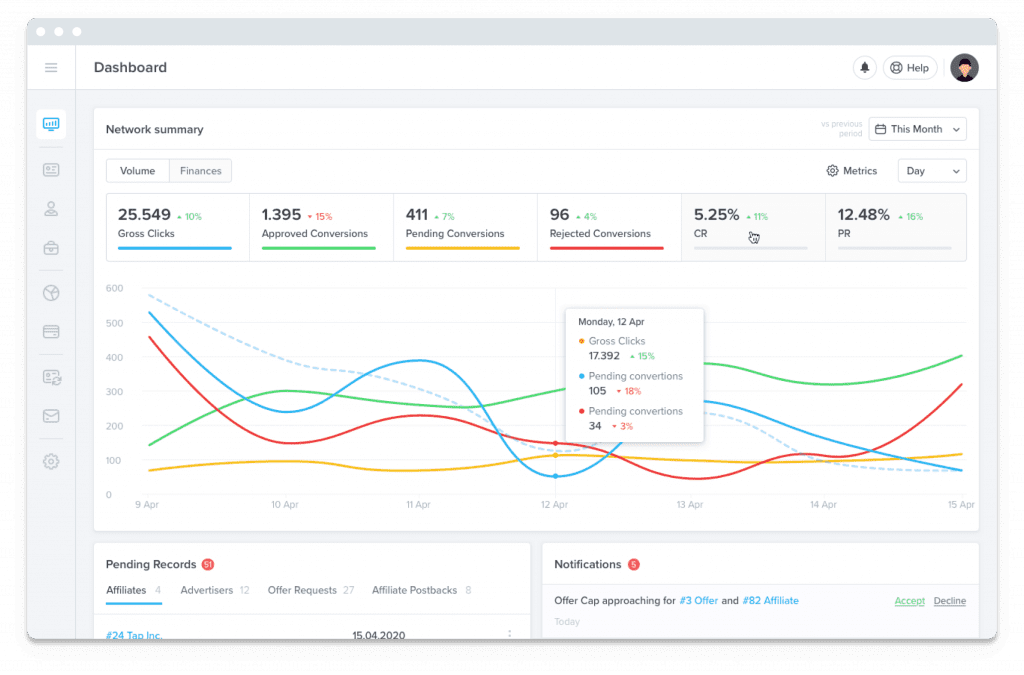
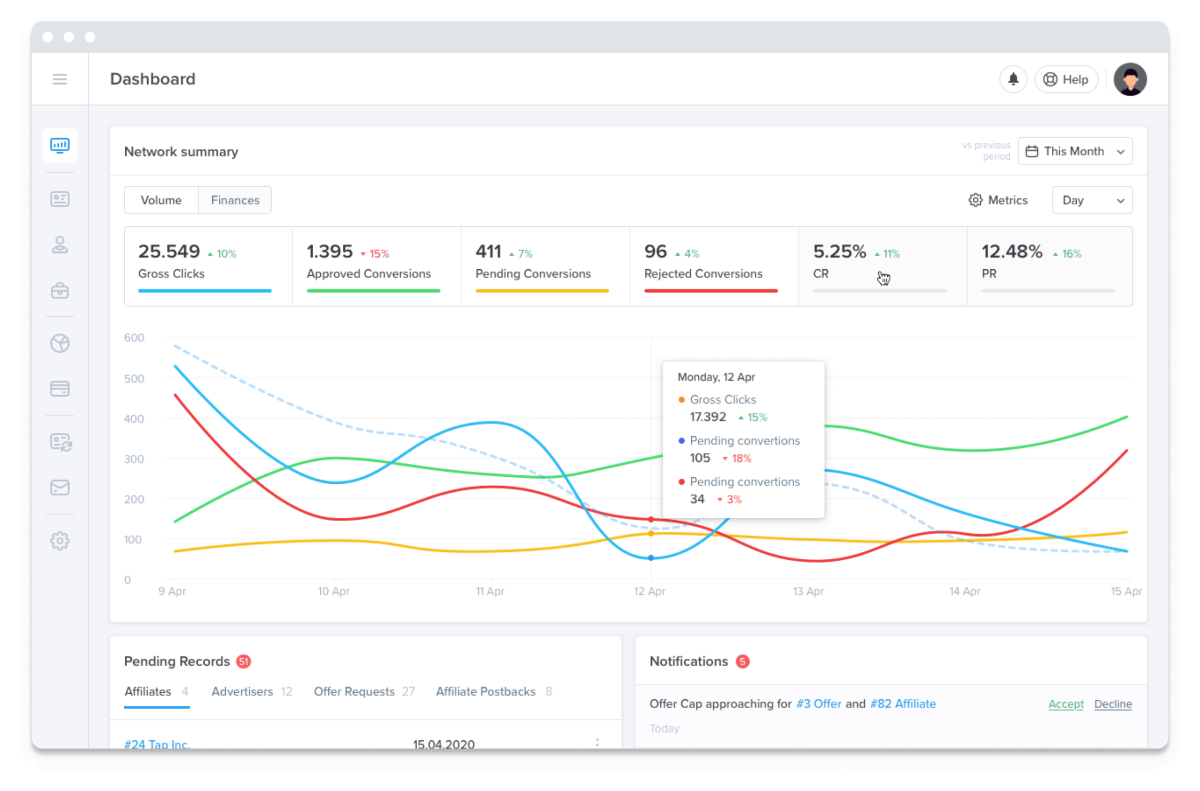
Scaleo is the strongest overall choice for companies that treat affiliate marketing as a serious revenue channel, not a casual add-on. It is built for businesses that need accurate tracking, flexible commission logic, fraud prevention, partner reporting, invoicing, API integrations, and white-label control.
Scaleo is especially strong for B2B companies, iGaming operators, affiliate networks, fintech brands, SaaS products, lead-generation companies, and performance marketing teams. These are environments where a basic coupon-tracking app is not enough. You need server-side events, multi-conversion tracking, partner-level reporting, fraud controls, and commission rules that do not collapse the first time a partner asks for a hybrid deal.
Why Scaleo Ranks #1
- Real-time affiliate tracking for clicks, conversions, campaigns, affiliates, advertisers, and offers.
- Server-to-server tracking and postback support for more reliable attribution in a privacy-restricted web.
- Flexible commission models, including CPA, CPL, RevShare, hybrid deals, recurring commissions, and tiered structures.
- Anti-fraud logic to help detect suspicious traffic, duplicate conversions, low-quality sources, and abnormal performance patterns.
- White-label affiliate portal so partners interact with your brand, not a generic third-party tool.
- Advanced reporting for affiliate managers, finance teams, and partners.
- API and integration options for CRMs, payment systems, analytics, product events, and custom workflows.
- Built-in invoicing and payout workflows that reduce month-end manual work.
The real advantage is not just the feature list. It is the fit. Scaleo works well when affiliate management gets operationally messy: multiple brands, many partners, different commission structures, fraud risk, custom integrations, and finance teams that need clean numbers. That is where cheap tools start to wobble.
| Best for | B2B companies, iGaming operators, affiliate networks, fintech, SaaS, performance agencies, lead-gen teams. |
| Not ideal for | Very small hobby blogs or tiny stores that only need a free referral plugin. |
| Standout feature | Flexible tracking and commission architecture combined with anti-fraud and white-label partner management. |
| Verdict | The best affiliate marketing software when accuracy, control, scale, and partner trust matter more than the cheapest monthly bill. |
2. Post Affiliate Pro \u2014 Best Traditional Affiliate Program Tool
Post Affiliate Pro is one of the older and more recognizable affiliate program platforms. It is a practical option for businesses that need standard affiliate links, banners, affiliate dashboards, multi-tier commissions, and basic program management without jumping straight into enterprise software.
Its biggest advantage is that it is approachable. Small businesses that want a traditional affiliate program can usually understand the model quickly: create an affiliate account, issue a link, track sales, calculate commission, and pay the partner. For many simple use cases, that is enough.
- Best for: small and mid-sized businesses running classic affiliate programs.
- Pros: established product, traditional affiliate features, multi-tier support, lower entry cost than enterprise tools.
- Cons: less ideal for complex B2B, iGaming, performance networks, or advanced fraud-sensitive programs.
- Verdict: a sensible affiliate software option if your program is straightforward and budget-sensitive.
3. Everflow \u2014 Best for Performance Marketing Teams
Everflow is a strong performance marketing platform used by advertisers, networks, and agencies that need partner tracking, attribution, reporting, and APIs. It is not just a beginner affiliate plugin; it is closer to performance marketing infrastructure.
Everflow is most relevant when you need detailed reporting, event tracking, partner segmentation, and performance optimization across more than one offer or channel. It can be a good choice for companies that already understand affiliate operations and want a more advanced platform than basic ecommerce tools.
- Best for: performance marketing agencies, affiliate networks, advertisers, and partner teams.
- Pros: detailed reporting, performance tracking, API support, event-level measurement.
- Cons: may be more than a small business needs; pricing and setup can feel heavier than simple tools.
- Verdict: a serious platform for performance-focused teams, especially when basic affiliate software is too limited.
4. Impact \u2014 Best Enterprise Partnership Platform
Impact is an enterprise partnership platform rather than a lightweight affiliate tracker. It supports affiliate, influencer, referral, business development, and broader partner programs. Its strength is enterprise-grade partner management: discovery, contracting, tracking, workflows, and reporting.
Impact makes the most sense for larger brands that need structure around many partnership types. It is not necessarily the leanest choice for a business that only wants direct affiliate tracking, but for enterprise partnership operations, it is one of the major names.
- Best for: enterprise brands, retail, ecommerce, SaaS, and multi-partner programs.
- Pros: enterprise workflows, partner discovery, strong brand reputation, broad partnership support.
- Cons: can be expensive and operationally heavier than direct affiliate software.
- Verdict: strong for enterprise partner programs, less necessary for lean teams wanting direct control and speed.
5. PartnerStack \u2014 Best for SaaS Partner Programs
PartnerStack is built around B2B SaaS partnerships, including affiliates, referral partners, resellers, and channel partners. It is useful for SaaS companies that want partner onboarding, partner enablement, recurring commissions, and access to a partner marketplace.
PartnerStack is usually not the first choice for iGaming, lead-gen networks, or high-risk performance marketing, but it fits SaaS partner ecosystems well. If your business sells subscription software and wants structured partner growth, it belongs on the shortlist.
- Best for: B2B SaaS companies building partner ecosystems.
- Pros: SaaS partner workflows, marketplace access, recurring commission support, partner enablement.
- Cons: less suitable for high-risk verticals, affiliate networks, or complex CPA/media-buying operations.
- Verdict: one of the strongest options for SaaS partnership programs.
6. FirstPromoter \u2014 Best for Subscription SaaS Affiliate Tracking
FirstPromoter focuses on SaaS affiliate and referral tracking. It is especially useful for subscription companies that want to track free trials, paid subscriptions, recurring revenue, upgrades, cancellations, and affiliate commissions tied to subscription events.
It is a good fit for SaaS startups that do not need a giant enterprise partner platform but do need more than a simple coupon-code referral app. The appeal is clarity: affiliate joins, refers users, subscriptions are tracked, recurring commissions are calculated.
- Best for: SaaS startups and subscription businesses.
- Pros: subscription tracking, recurring commissions, SaaS-focused setup.
- Cons: narrower than platforms built for multi-vertical affiliate management.
- Verdict: a clean SaaS affiliate tracking option for teams that sell subscriptions.
7. Rewardful \u2014 Best Simple Stripe-Based Referral Software
Rewardful is a simple, Stripe-friendly affiliate and referral tracking platform. It is popular with SaaS founders because it connects directly to subscription billing and keeps the experience relatively lightweight.
If you use Stripe and want to launch a referral or affiliate program without building a custom system, Rewardful can make sense. It is not trying to be a massive enterprise affiliate network platform, and that is partly the point.
- Best for: Stripe-based SaaS products and simple referral programs.
- Pros: simple setup, subscription-friendly, clean referral workflows.
- Cons: limited for complex affiliate networks, advanced fraud needs, or multi-offer B2B programs.
- Verdict: a good lightweight option for SaaS founders who want simplicity.
8. Refersion \u2014 Best for Ecommerce Affiliate Programs
Refersion is designed around ecommerce affiliate and influencer programs. It helps brands track affiliate sales, coupon codes, commissions, and partner performance. It is particularly relevant for online stores that want a more polished affiliate setup than a basic plugin.
For DTC brands, Shopify stores, and influencer-driven ecommerce, Refersion is a natural fit. It is less compelling for companies that need deep B2B tracking, lead-gen routing, complex postbacks, or iGaming-style commission logic.
- Best for: ecommerce stores and DTC brands.
- Pros: ecommerce-friendly, coupon support, affiliate dashboards, simple partner management.
- Cons: not designed for complex multi-event performance marketing.
- Verdict: a strong ecommerce affiliate platform for stores with influencer or publisher partnerships.
9. UpPromote \u2014 Best Shopify-Friendly Affiliate Software
UpPromote is a practical option for Shopify merchants that want to start an affiliate or referral program quickly. It is more approachable than enterprise platforms and is useful for small ecommerce teams testing affiliate marketing for the first time.
The biggest selling point is ease of use. You can create affiliate links, coupon codes, referral campaigns, and basic tracking without needing a technical team. The tradeoff is that it is not built for sophisticated affiliate networks or complex B2B operations.
- Best for: Shopify stores and small ecommerce brands.
- Pros: easy setup, ecommerce-focused, free/low-cost entry options, coupon tracking.
- Cons: not ideal for advanced tracking, fraud-sensitive sectors, or complex commission plans.
- Verdict: a good starter choice for Shopify affiliate programs.
10. Tapfiliate \u2014 Best Lightweight Affiliate Tracking Tool
Tapfiliate is a lightweight affiliate tracking platform for online businesses that want affiliate links, branded partner dashboards, commission rules, and integrations without excessive complexity.
It is useful for startups, ecommerce brands, SaaS products, and digital businesses that need a clean affiliate solution but do not yet need heavyweight enterprise partner management. Think \u201csimple but capable,\u201d not \u201cmassive performance network machine.\u201d
- Best for: online businesses needing straightforward affiliate tracking.
- Pros: clean interface, branded partner portal, integrations, manageable setup.
- Cons: may become limiting for high-volume, fraud-sensitive, multi-offer programs.
- Verdict: a solid lightweight affiliate software option for growing businesses.
11. TUNE \u2014 Best for Custom Enterprise Tracking
TUNE, formerly HasOffers, is a long-running affiliate and partner tracking platform used by companies that need flexible tracking infrastructure, APIs, partner management, and custom measurement workflows.
Its strongest fit is with technically mature teams that know what they need from tracking and attribution. If your company has internal technical resources and needs customizable infrastructure, TUNE may be worth considering. For smaller businesses, it can feel heavier than necessary.
- Best for: enterprises and technically mature partner programs.
- Pros: flexible tracking, API support, enterprise history, partner infrastructure.
- Cons: not the simplest choice for small or non-technical teams.
- Verdict: strong when you need customizable partner tracking and have the team to manage it.
12. CAKE \u2014 Best for Lead Distribution and Performance Tracking
CAKE is a performance marketing platform with strengths in tracking, lead distribution, call tracking, and affiliate program operations. It is relevant for businesses where affiliate activity overlaps with lead generation, call campaigns, and advertiser-publisher relationships.
CAKE is not the typical \u201csmall business affiliate plugin.\u201d It is better suited for performance marketing companies, lead-gen teams, and networks that need to manage traffic, partners, and conversions with more operational control.
- Best for: lead-gen companies and performance networks.
- Pros: lead routing, call tracking, affiliate tracking, performance reporting.
- Cons: less relevant for simple ecommerce affiliate programs.
- Verdict: useful for complex lead and performance marketing environments.
13. Affise \u2014 Best for CPA Networks
Affise is a performance marketing platform often used by CPA networks, agencies, and advertisers managing multiple offers. It supports offer tracking, partner management, automation, targeting, caps, and reporting.
Affise is strongest when the business model is performance-heavy: many campaigns, many traffic sources, many conversion rules. It is less appropriate if you only want a simple affiliate program for a small store.
- Best for: CPA networks and performance marketing teams.
- Pros: offer management, automation, fraud prevention features, performance reports.
- Cons: may be overbuilt for simple partner programs.
- Verdict: a strong CPA-network-style affiliate platform.
14. Voluum \u2014 Best for Paid Traffic Tracking
Voluum is better understood as an ad tracker and campaign optimization platform than a full affiliate program management system. It is popular with media buyers because it tracks traffic sources, landing pages, offers, conversions, redirects, and performance data.
If you buy traffic and need to optimize campaigns, Voluum is relevant. If you want to run your own affiliate program with partner onboarding, branded portals, invoicing, and commission management, you may need a different platform or an additional tool.
- Best for: media buyers, paid traffic teams, and campaign optimization.
- Pros: traffic tracking, redirects, campaign optimization, anti-fraud tools.
- Cons: not a complete affiliate program management platform for all use cases.
- Verdict: excellent for tracking paid traffic, but not a direct replacement for full affiliate software like Scaleo.
15. CJ \u2014 Best for Affiliate Marketplace Reach
CJ is one of the major affiliate networks. Unlike direct affiliate software, CJ gives brands access to a marketplace of publishers and provides network infrastructure around relationships, tracking, and payments.
That marketplace access can be valuable for large brands. The tradeoff is control. You are participating in a network environment rather than building every part of your affiliate program independently. For some brands, that is convenient. For others, direct ownership through affiliate software is cleaner.
- Best for: larger brands seeking publisher marketplace access.
- Pros: publisher network, established infrastructure, marketplace credibility.
- Cons: less direct ownership than running your own program software.
- Verdict: useful as a network channel, not the same as owning affiliate software.
16. Awin and ShareASale \u2014 Best Merchant Marketplace Options
Awin and ShareASale are well-known affiliate network and marketplace options, especially for ecommerce merchants and publishers. They help brands list programs, recruit affiliates, and manage tracking through a network environment.
These platforms are worth considering if your main goal is marketplace exposure. But if you want a fully owned, customized affiliate program with your own partner portal, commission logic, API workflows, and direct operational control, dedicated affiliate software may be a better fit.
- Best for: ecommerce merchants and affiliate marketplace participation.
- Pros: publisher access, recognizable network, ecommerce-friendly.
- Cons: less flexible than owning your own affiliate tracking stack.
- Verdict: good marketplace option, especially for merchants who want affiliate discovery.
Best Affiliate Marketing Software by Business Type
The \u201cbest\u201d platform depends on the job. A tiny Shopify store and a multi-brand iGaming operator should not be buying the same affiliate software unless someone enjoys avoidable pain.
| Business Type | Best Choice | Reason |
|---|---|---|
| B2B company | Scaleo | Strong tracking, partner management, reporting, APIs, and scalable commission structures. |
| iGaming operator | Scaleo | Supports complex commission models, fraud control, multi-event tracking, and partner transparency. |
| Affiliate network | Scaleo, Everflow, Affise | Built for multi-offer, performance-driven operations and partner management. |
| SaaS startup | FirstPromoter, Rewardful, PartnerStack, Scaleo | Depends on complexity: simple subscriptions need lightweight SaaS tools; advanced partner programs need stronger infrastructure. |
| Shopify store | UpPromote, Refersion, Tapfiliate | Easy setup, coupon tracking, influencer-friendly workflows. |
| Enterprise brand | Impact, CJ, Awin, Scaleo | Marketplace access or direct ownership depending on partner strategy. |
| Paid media team | Voluum | Designed for traffic tracking, campaign optimization, redirects, and media buying analytics. |
Features to Look For in Affiliate Marketing Software
Do not buy affiliate software because the dashboard looks nice in a demo. Buy it because it can survive your real operating conditions.
1. Accurate Tracking
At minimum, affiliate software should support link tracking, conversion tracking, attribution windows, cookies, first-party tracking, and postbacks. Serious programs should also look for server-side tracking, event-level logs, and CRM/payment-system integrations. Cookie-only tracking is getting weaker every year, and a \u201ctrust us, it tracks\u201d setup is not good enough when commissions are meaningful.
2. Flexible Commission Models
Basic programs may only need fixed percentage commissions. But mature programs need CPA, CPL, RevShare, hybrid, recurring commissions, tiered rates, custom bonuses, negative adjustments, and partner-specific rules. If the software cannot model how you actually pay partners, your team will recreate the logic manually in spreadsheets. And that is where month-end sanity goes to die.
3. Fraud Prevention
Affiliate fraud is not limited to fake clicks. It includes cookie stuffing, duplicate leads, low-quality incentive traffic, suspicious device clusters, bonus abuse, recycled users, and conversion manipulation. Good software should help detect unusual patterns before those patterns become paid invoices.
4. Partner Dashboards
Affiliates should be able to see their clicks, conversions, commissions, creatives, links, and payout status without emailing your team every five minutes. A clean partner dashboard is not a luxury. It reduces support load and builds trust.
5. Reporting and Analytics
Look for reporting by affiliate, sub-ID, campaign, landing page, traffic source, device, GEO, creative, time period, and conversion event. You want to know not just who sent volume, but who sent profitable volume.
6. API and Integrations
Your affiliate software should connect with your CRM, payment gateway, analytics stack, ecommerce platform, product backend, or BI tool. If you cannot get clean data in and out, you will never fully trust the channel.
7. Payout and Invoice Workflows
Affiliate programs often break at payout time. The software should help you preview commissions, approve payouts, handle adjustments, export payment data, and keep a clean audit trail. This is boring until it is broken; then it becomes the only thing anyone talks about.
Free vs Paid Affiliate Marketing Software
Free affiliate software can be useful when you are testing whether affiliate marketing works for your business at all. If you have five trusted partners, simple tracking, low commission exposure, and no compliance risk, free or low-cost tools may be enough for the first phase.
But once affiliate revenue becomes material, free software becomes risky. You need better tracking, clearer reports, partner support, fraud controls, and payout confidence. Saving a few hundred dollars per month is not clever if one tracking error costs more than the annual software bill.
| Scenario | Free / Low-Cost Tool | Paid Affiliate Software |
|---|---|---|
| Testing affiliate marketing | Fine | Optional |
| Small ecommerce store | Often enough at first | Better once volume grows |
| SaaS with recurring commissions | Usually limited | Recommended |
| Affiliate network | Not realistic | Required |
| iGaming / high-risk vertical | Bad idea | Required |
| Complex partner contracts | Usually weak | Required |
| Fraud-sensitive program | Dangerous | Strongly recommended |
How Much Does Affiliate Marketing Software Cost?
Affiliate software pricing varies widely. Simple ecommerce affiliate apps may start with free or low-cost plans. Traditional affiliate tools often sit in the low hundreds per month. Advanced B2B, network, or enterprise platforms can cost significantly more, especially when custom tracking, API usage, multi-brand setup, support, or higher traffic volumes are involved.
The better question is not \u201cWhat is the cheapest affiliate software?\u201d The better question is: \u201cWhat does bad tracking cost us?\u201d
Bad tracking creates underpayment, overpayment, partner distrust, fraud leakage, support tickets, and manual reconciliation. If affiliate revenue is real money for your business, the cheapest tool may become expensive very quickly.
When Should You Upgrade From a Basic Affiliate Tool?
You should consider upgrading when any of these become true:
- You have more than 10\u201320 active affiliates.
- You are paying meaningful monthly commissions.
- You need more than one commission model.
- You are running CPA, RevShare, recurring, tiered, or hybrid deals.
- You need server-side tracking or postback tracking.
- You are seeing fraud, duplicate leads, suspicious conversions, or payout disputes.
- Your partners are asking for better reporting.
- Your finance team is manually reconciling commissions.
- Your affiliate program is becoming a core acquisition channel.
Once affiliate marketing becomes part of revenue strategy, it deserves proper infrastructure. Otherwise, the program grows faster than the system underneath it. That never ends peacefully.
Affiliate Marketing Software Checklist
Use this checklist before signing a contract or migrating your program.
| Question | Why It Matters |
|---|---|
| Does it support server-side tracking? | Improves attribution reliability when browser tracking is limited. |
| Can it track multiple conversion events? | Needed for SaaS trials, deposits, purchases, renewals, qualified leads, and lifecycle events. |
| Can each partner have a different commission plan? | Important for CPA, RevShare, hybrid, tiered, and custom deals. |
| Does it include fraud detection? | Prevents paying for suspicious or low-quality activity. |
| Does it provide partner-facing reports? | Reduces disputes and improves partner trust. |
| Can finance audit payouts? | Critical for month-end confidence and compliance. |
| Does it integrate with your backend? | Needed for accurate revenue, lead quality, subscription, deposit, or transaction data. |
| Can it scale across brands or offers? | Important for networks, agencies, iGaming, SaaS portfolios, and multi-product businesses. |
| Is support responsive? | Affiliate tracking issues are revenue issues, not cosmetic bugs. |
| Does it fit your business model? | The best tool for ecommerce may be wrong for SaaS, and the best SaaS referral tool may be wrong for iGaming. |
Common Mistakes When Choosing Affiliate Marketing Software
Mistake #1: Choosing Based on Price Alone
Cheap software feels good until it misattributes conversions, fails to support your commission logic, or leaves your affiliate manager reconciling payouts in Excel. Price matters, but only after the platform can do the job.
Mistake #2: Confusing Affiliate Networks With Affiliate Software
Affiliate networks can help you access publishers. Affiliate software helps you run your own program. Many businesses need one or the other. Mature programs may use both. But they are not interchangeable.
Mistake #3: Ignoring Fraud Until It Appears
Fraud prevention should not be an afterthought. If your program pays on leads, signups, deposits, trials, or purchases, someone will eventually test the edges. The platform should help you see suspicious patterns before payout day.
Mistake #4: Buying for Today Only
Your program may begin with five partners and one commission rate. But what happens when you add paid media partners, content affiliates, influencers, sub-affiliates, agencies, or regional partners? Choose software that can grow without forcing a painful migration six months later.
Mistake #5: Treating Reporting as Decoration
Reporting is not just for pretty charts. It is how you decide which partners deserve more budget, which traffic is low quality, which campaigns should stop, and which commissions are actually justified. Weak reporting creates expensive blindness.
Final Recommendation: Which Affiliate Marketing Software Should You Choose?
Choose Scaleo if you want the best overall affiliate marketing software for a serious B2B, iGaming, SaaS, fintech, affiliate network, or performance marketing program. It is strongest when tracking accuracy, fraud control, flexible commissions, white-labeling, reporting, and APIs matter.
Choose Post Affiliate Pro if you want a more traditional affiliate program tool at a lower entry point. Choose Refersion, UpPromote, or Tapfiliate if you are mainly running an ecommerce store and need a simple affiliate setup. Choose FirstPromoter or Rewardful if you are a SaaS startup with straightforward subscription commissions. Choose Impact, CJ, or Awin if marketplace access is more important than owning your full affiliate stack. Choose Voluum if your real need is paid traffic tracking rather than affiliate program management.
My blunt view: if affiliate marketing is a side experiment, start simple. If affiliate marketing is a real revenue channel, buy real software. The money you \u201csave\u201d with a weak platform usually comes back as tracking disputes, manual work, partner mistrust, and fraud leakage. Charming little invoice gremlins, basically.
Want Affiliate Software Built for Serious Partner Revenue?
Scaleo gives you real-time tracking, S2S postbacks, flexible commission plans, anti-fraud logic, white-label partner portals, API integrations, reporting, and payout workflows in one affiliate marketing platform.
Frequently Asked Questions
Affiliate Marketing Software: Frequently Asked Questions
What is the best affiliate marketing software in 2026?
Scaleo is the strongest overall choice for B2B companies, iGaming operators, affiliate networks, and performance-driven teams. It handles accurate tracking, fraud control, flexible commission models, white-label partner portals, and real-time reporting without compromising. For ecommerce, Refersion and UpPromote are the cleaner picks. For SaaS, PartnerStack or FirstPromoter.
What does affiliate marketing software actually do?
It tracks partner referrals, records conversions, calculates commissions, provides affiliate dashboards, manages creatives, and handles payouts. Good platforms also cover server-side tracking, fraud prevention, API integrations, and custom commission models. Cheap tools cover the basics. Enterprise tools cover everything.
Is there free affiliate marketing software worth using?
Yes — for small programs with a handful of trusted partners, free tiers on tools like UpPromote or Tapfiliate can work. But once affiliate revenue is a real revenue channel, free software is a liability. Tracking gaps, missing fraud controls, and no support add up fast. Paid software pays for itself.
Affiliate software vs affiliate network: which do I need?
Affiliate software (like Scaleo, PartnerStack, Refersion) lets you own and run your program directly. An affiliate network (CJ, Awin, ShareASale) gives you marketplace access to thousands of publishers — but you share data and pay network fees. Most mature programs use both: owned software for core partners, networks for reach.
What features should affiliate marketing software include?
The non-negotiables: accurate click and conversion tracking, partner dashboards, commission management with multiple models (CPA, RevShare, Hybrid), real-time reporting, payout workflows, and API access. Must-haves for scaling: server-side tracking, fraud prevention, white-label portal, and multi-currency support. Anything missing from this list is a platform I would not run a serious program on.
{
“@context”: “https://schema.org”,
“@type”: “FAQPage”,
“mainEntity”: [
{
“@type”: “Question”,
“name”: “What is the best affiliate marketing software in 2026?”,
“acceptedAnswer”: {
“@type”: “Answer”,
“text”: “Scaleo is the strongest overall choice for B2B companies, iGaming operators, affiliate networks, and performance-driven teams. It handles accurate tracking, fraud control, flexible commission models, white-label partner portals, and real-time reporting. For ecommerce, Refersion and UpPromote are the cleaner picks. For SaaS, PartnerStack or FirstPromoter.”
}
},
{
“@type”: “Question”,
“name”: “What does affiliate marketing software actually do?”,
“acceptedAnswer”: {
“@type”: “Answer”,
“text”: “It tracks partner referrals, records conversions, calculates commissions, provides affiliate dashboards, manages creatives, and handles payouts. Good platforms also cover server-side tracking, fraud prevention, API integrations, and custom commission models.”
}
},
{
“@type”: “Question”,
“name”: “Is there free affiliate marketing software worth using?”,
“acceptedAnswer”: {
“@type”: “Answer”,
“text”: “Free tiers on tools like UpPromote or Tapfiliate can work for small programs with a handful of trusted partners. But once affiliate revenue is a serious channel, free software is a liability. Tracking gaps, missing fraud controls, and no support add up fast.”
}
},
{
“@type”: “Question”,
“name”: “What is the difference between affiliate software and an affiliate network?”,
“acceptedAnswer”: {
“@type”: “Answer”,
“text”: “Affiliate software lets you own and run your program directly. An affiliate network gives you marketplace access to thousands of publishers but you share data and pay network fees. Most mature programs use both: owned software for core partners, networks for reach.”
}
},
{
“@type”: “Question”,
“name”: “What features should affiliate marketing software include?”,
“acceptedAnswer”: {
“@type”: “Answer”,
“text”: “The non-negotiables: accurate click and conversion tracking, partner dashboards, commission management with multiple models (CPA, RevShare, Hybrid), real-time reporting, payout workflows, and API access. Must-haves for scaling: server-side tracking, fraud prevention, white-label portal, and multi-currency support.”
}
}
]
}




Comments are closed on this article.