
Claude Opus vs Sonnet for Content Marketing: Which Claude Model Writes Better?

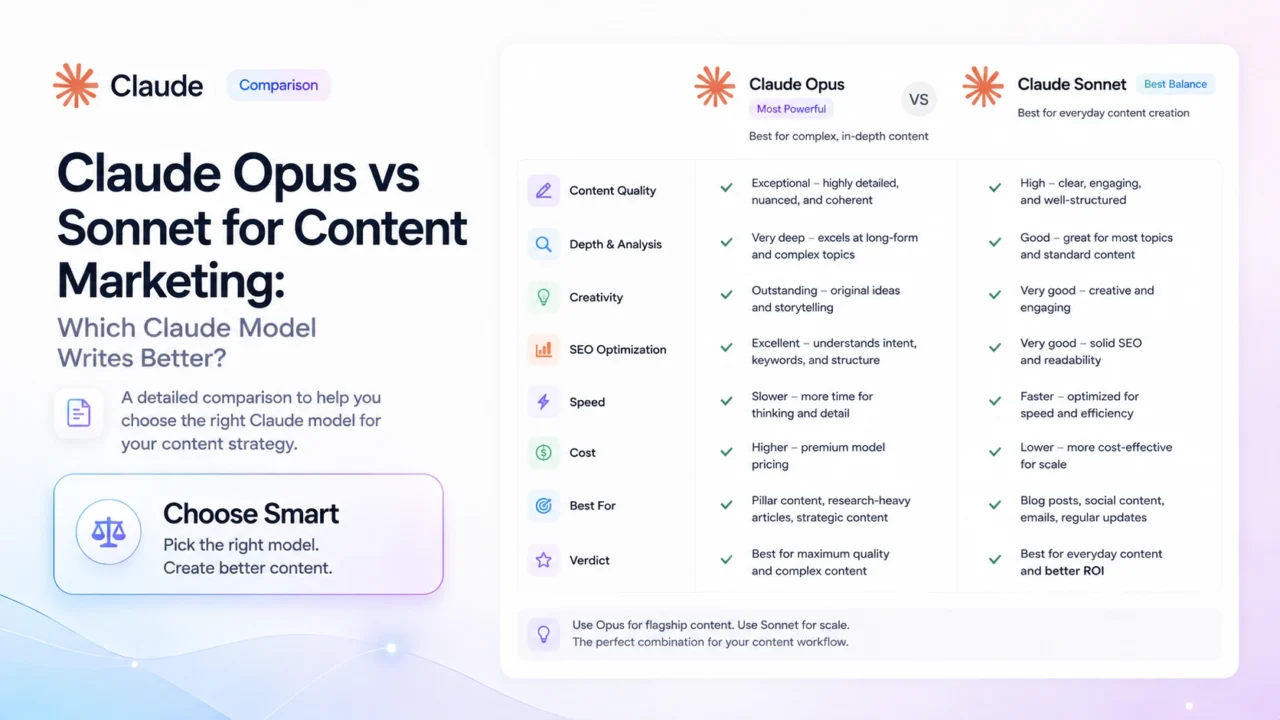
Claude Opus 4.1 vs Claude Sonnet 4.5 is not a simple “which model is smarter?” question. For content marketers, the better question is: which Claude model gives you stronger final content, cleaner strategic synthesis, and better cost efficiency for the kind of work you actually do every week?
I tested both models on the same real content marketing task: creating a weekly AI marketing brief from multiple source articles, using the same structure, the same voice instructions, and the same expected output.
The result surprised me a little. Claude Opus 4.1 felt more creative, more energetic, and more willing to make bold editorial moves. Claude Sonnet 4.5 produced the stronger final draft. Not because it was flashier, but because it synthesized better, sounded more credible, and gave more useful strategic takeaways.
⚡ Direct Answer
Claude Sonnet 4.5 is the better daily model for most content marketers. It gives cleaner analysis, better source synthesis, stronger practical recommendations, and much better cost efficiency. Claude Opus 4.1 is better when you want more expressive creative direction, high-energy ideation, or a more dramatic editorial voice. If you are writing newsletters, SEO briefs, thought-leadership articles, or executive summaries, Sonnet 4.5 is the safer default. If you are brainstorming angles, campaign concepts, or unusual hooks, Opus 4.1 still has a place.
Claude Opus 4.1 vs Claude Sonnet 4.5: Quick Verdict
| Category | Claude Opus 4.1 | Claude Sonnet 4.5 | Winner |
|---|---|---|---|
| Best for | Creative ideation, bold angles, expansive drafts | Strategic synthesis, polished marketing content, structured analysis | Depends on task |
| Writing voice | Bigger, more energetic, more dramatic | More grounded, controlled, and credible | Sonnet 4.5 |
| Strategic thinking | Good, but sometimes broader than necessary | Sharper, more practical, better connected to business outcomes | Sonnet 4.5 |
| Source synthesis | Strong summaries, punchy framing | Better at connecting themes across sources | Sonnet 4.5 |
| Creativity | More colorful and metaphor-heavy | Creative but less theatrical | Opus 4.1 |
| SEO content usefulness | Good first drafts, but needs tightening | Better structure, stronger answer-first logic | Sonnet 4.5 |
| Cost efficiency | Historically expensive compared with Sonnet-class models | Much better value for recurring marketing workflows | Sonnet 4.5 |
| My recommendation | Use for ideation and premium creative thinking | Use as the default content production model | Sonnet 4.5 |
Important Update: What About Claude Opus 4.5?
This test originally compared Claude Opus 4.1 with Claude Sonnet 4.5. Since then, Anthropic released Claude Opus 4.5, which changes the high-end Claude recommendation for some use cases.
That does not make this comparison useless. It just means the conclusion needs to be precise:
- If you are choosing between Opus 4.1 and Sonnet 4.5 for content marketing, Sonnet 4.5 is usually the better everyday choice.
- If you have access to Opus 4.5 and the task is genuinely complex, high-stakes, or research-heavy, Opus 4.5 may be the stronger premium option.
- If your goal is cost-efficient daily content production, Sonnet 4.5 remains extremely hard to beat.
In plain English: Sonnet 4.5 is the sensible workhorse. Opus is the expensive specialist. Don’t use the specialist when the workhorse already does the job beautifully.
Model Context: What Are We Actually Comparing?
Before judging the output, it helps to understand the model positioning. Claude model names can sound like perfume names after a while — Opus, Sonnet, Haiku — but they do mean different things.
| Model | Positioning | Best known for | Content marketing fit |
|---|---|---|---|
| Claude Opus 4.1 | Older premium Opus model | Complex reasoning, agentic tasks, coding, research, deeper analysis | Useful for demanding creative strategy and complex synthesis, but often more expensive than needed for routine content work |
| Claude Sonnet 4.5 | High-performance balanced model | Reasoning, agents, computer use, coding, structured work, everyday productivity | Excellent default for newsletters, SEO articles, briefs, summaries, research synthesis, and thought leadership |
| Claude Opus 4.5 | Newer premium Opus model | Advanced reasoning, coding, agents, computer use, enterprise workflows, spreadsheets, deep research | Potentially better for very complex strategy work, but not always necessary for ordinary marketing output |
The key point: more premium does not automatically mean better for every marketing task. A model can be more capable in absolute terms and still be the wrong default if it is slower, more expensive, or more likely to overcomplicate simple work.
The Test: One Prompt, Two Claude Models
I ran the same weekly AI marketing newsletter prompt through both models. Same source material. Same format. Same voice instructions. No extra hand-holding for either model.
This was not a toy prompt like “write a blog post about AI.” It was closer to real marketing work, where the model has to read, compare, synthesize, prioritize, and produce something that sounds like a thinking human wrote it.
The Task Required
- Synthesizing information from multiple source articles
- Maintaining a consistent newsletter voice
- Structuring the brief into repeatable sections
- Explaining why each AI development matters to marketers
- Adding strategic commentary, not just summaries
- Creating useful takeaways a working marketer could act on
The Exact Prompt Pattern I Used
Create my weekly AI marketing brief from the source articles below. Use a conversational but intelligent tone. The audience is content marketers, SEO strategists, founders, and solo operators using AI in their marketing workflows.
Structure the brief like this:
1. Strong opening insight2. Main theme of the week3. Key AI marketing news items4. Why each item matters5. Battle of the Week6. Practical action item7. Final takeaway
Do not merely summarize. Connect the dots between the sources. Add original strategic commentary. Make it useful, sharp, and readable.
That last line matters: “Do not merely summarize.” This is where a lot of AI writing falls apart. Many models can summarize. Fewer can turn five scattered updates into one coherent editorial thesis.
First Impressions: Opus 4.1 Had More Spark, Sonnet 4.5 Had More Control
Claude Opus 4.1 came out swinging. Its opening had energy, confidence, and a clear editorial hook. It felt like a newsletter written by someone who wanted to grab the reader by the collar and say, “Pay attention. This matters.”
Its tone was bold, almost motivational. It leaned heavily into metaphor and big framing. That can be useful, especially when you want a memorable angle. But there is a thin line between strong editorial voice and “AI discovered metaphors and now refuses to stop using them.” Opus got close to that line.
Claude Sonnet 4.5 opened with a quieter but sharper kind of confidence. It felt less like a keynote and more like a smart colleague explaining what actually changed this week and why you should care. The writing was still engaging, but it carried more editorial restraint.
My first reaction: Opus 4.1 sounded more like a talented creative writer. Sonnet 4.5 sounded more like a strategist who writes well. For content marketing, that difference matters.
Writing Voice: Bold vs Credible
The biggest stylistic difference was voice. Opus 4.1 liked strong hooks, repeated motifs, and emotionally charged framing. Sonnet 4.5 used more controlled language and let the analysis carry more of the weight.
Here is the practical difference:
| Writing Element | Claude Opus 4.1 | Claude Sonnet 4.5 |
|---|---|---|
| Hooks | Bolder and more dramatic | Still strong, but more grounded |
| Metaphors | More frequent and sometimes overextended | Used more sparingly |
| Tone | Inspirational, energetic, occasionally theatrical | Strategic, conversational, more credible |
| Sentence flow | Punchy but sometimes choppy | Smoother and more natural |
| Editing needed | Mostly trimming repetition and toning down drama | Mostly minor polish |
If you are writing a hype-style product launch, Opus 4.1’s energy can be useful. If you are writing thought leadership, a CEO memo, an SEO article, or a newsletter that needs to build trust, Sonnet 4.5 is easier to publish.
Structure and Organization: Sonnet 4.5 Was Cleaner
Both models understood the requested newsletter structure. Neither failed the task. But they handled organization differently.
Claude Opus 4.1 Structure
- Strong section breaks
- Very clear visual hierarchy
- More dramatic transitions
- Heavy use of a central metaphor
- Good readability, but sometimes too branded around one idea
Claude Sonnet 4.5 Structure
- Cleaner progression between points
- Less dependency on gimmicks
- More natural transitions
- Better balance between sections
- Stronger editorial discipline
Opus 4.1 felt like it was trying harder to make the piece memorable. Sonnet 4.5 felt like it was trying harder to make the piece useful. In content marketing, useful usually wins.
Content Depth: Sonnet 4.5 Connected the Dots Better
This was the real difference.
Both models could summarize the source articles. Both could pull out key points. Both could produce a polished draft. But Sonnet 4.5 was better at connecting ideas across sources and turning them into a coherent argument.
Opus 4.1 often gave me a good soundbite. Sonnet 4.5 gave me the underlying implication.
Example difference: Opus 4.1 was better at saying “this is interesting.” Sonnet 4.5 was better at saying “this is interesting because it changes how marketing teams should structure their AI workflows.” That second version is the one I can actually use.
The “Workslop” Test: Soundbite vs Insight
One of the source items discussed the problem of AI-generated “workslop”: content that looks finished but creates cleanup work for everyone else. This was a perfect test because it required the model to do more than repeat a funny term. It had to explain the business problem.
Opus 4.1 turned it into a punchy line. It was catchy, readable, and memorable. But it was closer to a newsletter hook than a strategic explanation.
Sonnet 4.5 explained the operational issue: AI content is not automatically productivity. Without workflow design, review standards, and quality control, AI can multiply low-value work instead of reducing it.
That is the kind of distinction content marketers need. Not “AI bad” or “AI good.” The useful point is: AI only saves time when the workflow around it is designed properly.
Strategic Thinking: Sonnet 4.5 Won Clearly
This is where I saw the biggest gap.
Opus 4.1 gave useful strategic advice, but it tended to stay at the level of broad positioning. For example: stop thinking of AI as individual tools and start thinking in terms of orchestration. That is good advice. But I have seen that advice many times now.
Sonnet 4.5 went a level deeper. It made a sharper distinction between AI experimentation and AI integration. That is much more useful because it describes the real shift happening inside marketing teams.
Most marketers are no longer asking, “Can AI help me write?” They already know it can. The better question is: Where does AI belong inside the workflow without making everything messier?
Sonnet 4.5 understood that distinction better.
Side-by-Side Scoring
Here is my subjective scoring after reviewing both outputs as a working content marketer, not as a model benchmark scientist.
| Category | Claude Opus 4.1 | Claude Sonnet 4.5 | Notes |
|---|---|---|---|
| Hook strength | 9/10 | 8.5/10 | Opus was more dramatic; Sonnet was more credible. |
| Voice authenticity | 8/10 | 9/10 | Sonnet sounded more like a human strategist, less like a model trying to impress. |
| Source synthesis | 8/10 | 9.5/10 | Sonnet connected themes across sources more naturally. |
| Strategic insight | 7.5/10 | 9.5/10 | Sonnet produced more implementable observations. |
| Structure | 8/10 | 9/10 | Opus had strong formatting; Sonnet had better flow. |
| Creativity | 9/10 | 8/10 | Opus was better for angle generation and colorful framing. |
| Actionability | 7/10 | 9/10 | Sonnet gave clearer next steps. |
| Editing required | More | Less | Opus needed tone trimming; Sonnet needed light polish. |
| Best final draft | 8/10 | 9.5/10 | Sonnet was easier to publish. |
Cost Efficiency: The Part Marketers Should Not Ignore
Content marketers love comparing output quality, but cost matters too. Especially if you are using the API, building AI workflows, or producing content at scale.
A model that is 10% better but costs several times more is not always the better business choice. For one premium strategy memo, maybe. For weekly newsletters, SEO refreshes, metadata, briefs, and social repurposing? Probably not.
This is where Sonnet 4.5 becomes very attractive. It gives premium-quality marketing output without feeling like you need to reserve it only for “important” tasks.
| Workflow | Better Default | Why |
|---|---|---|
| Weekly newsletter draft | Claude Sonnet 4.5 | Strong synthesis and cost efficiency |
| SEO blog article | Claude Sonnet 4.5 | Better structure, more practical answer-first writing |
| Thought-leadership article | Claude Sonnet 4.5 | More credible tone and stronger reasoning |
| Creative campaign brainstorming | Claude Opus 4.1 or Opus 4.5 | More expansive, unusual, and metaphor-rich |
| Brand voice exploration | Claude Opus 4.1 | More stylistic range |
| Complex research synthesis | Sonnet 4.5 or Opus 4.5 | Sonnet for most cases; Opus 4.5 for high-stakes depth |
| Final editorial polish | Claude Sonnet 4.5 | Cleaner and less overdone |
Best Claude Model for SEO Content
For SEO content, I would choose Claude Sonnet 4.5 as the default.
SEO content needs more than attractive sentences. It needs structure, search-intent coverage, direct answers, useful headings, logical flow, and enough specificity to avoid sounding like every other AI-generated article on the internet.
Opus 4.1 can write beautiful sections, but it is more likely to over-style the piece. Sonnet 4.5 tends to stay closer to the reader’s problem. That makes it better for:
- comparison posts
- buyer guides
- how-to articles
- SEO content briefs
- content refreshes
- FAQ expansion
- structured thought-leadership posts
My ideal workflow would be: use Opus for angle discovery, then Sonnet for the actual SEO draft. That gives you the spark without letting the spark burn down the structure.
Best Claude Model for Newsletters
For newsletters, Sonnet 4.5 also wins — with one caveat.
If your newsletter brand is built around personality, wit, and strong editorial voice, Opus 4.1 can be useful for generating bold opening angles. It is good at creating energy. But if your newsletter needs to synthesize multiple articles and deliver useful business insights, Sonnet 4.5 gives a better finished product.
In my test, Opus wrote the version that felt more “shareable.” Sonnet wrote the version I would be more comfortable sending to a serious professional audience.
Best Claude Model for Thought Leadership
Thought leadership is where Sonnet 4.5 really shines.
Good thought leadership does not just say something confidently. It needs to make a useful distinction that helps the reader see the problem differently. Sonnet 4.5 was better at that. It created more precise business framing and less decorative language.
That matters because many AI-written thought-leadership posts suffer from the same disease: they sound profound until you ask, “What exactly did this teach me?” Sonnet 4.5 was better at avoiding that trap.
When Claude Opus 4.1 Is Still Worth Using
I do not want this to sound like Opus 4.1 failed. It did not. It produced good content. If I had only seen the Opus version, I would have been impressed.
The issue is that Sonnet 4.5 produced better content for this specific use case.
I would still use Opus 4.1 for:
- brainstorming unusual article angles
- developing campaign concepts
- creating bold newsletter hooks
- exploring brand voice options
- generating multiple creative directions before choosing one
- high-level strategy work where creativity matters more than cost
Opus is good when you want range. Sonnet is better when you want a reliable final answer.
When Claude Sonnet 4.5 Is the Better Choice
Sonnet 4.5 is the model I would use for most recurring content marketing work.
Use Sonnet 4.5 when you need:
- a polished first draft
- a newsletter based on multiple sources
- a practical SEO article
- a structured content brief
- a thought-leadership post that should sound credible
- source synthesis without excessive drama
- clear action items from messy input
- a model that gives strong results without premium-model guilt
That last point is not trivial. A model you can use often is more valuable than a model you reserve for special occasions.
The Content Marketer’s Practical Workflow
If you have access to both models, I would not treat this as an either-or decision. The smarter approach is to give each model the part of the workflow it handles best.
| Stage | Recommended Model | Prompt Style |
|---|---|---|
| Angle discovery | Opus 4.1 or Opus 4.5 | “Give me 10 unexpected angles for this topic, including contrarian and high-authority angles.” |
| Outline | Sonnet 4.5 | “Turn the best angle into an SEO-friendly structure that answers the reader’s intent directly.” |
| First draft | Sonnet 4.5 | “Write the article with clear headings, direct answers, and useful examples.” |
| Voice pass | Opus or Sonnet | “Make this sharper, more human, and less generic without adding fluff.” |
| Final polish | Sonnet 4.5 | “Tighten logic, remove repetition, improve transitions, and keep the tone credible.” |
This workflow gives you the best of both worlds: Opus for creative expansion, Sonnet for editorial discipline.
My Honest Final Verdict
Claude Opus 4.1 is impressive. It can write engaging, polished, high-energy content. It is especially good when you want expressive language, strong framing, and a creative push.
But for the kind of content marketing I actually care about — newsletters, strategic articles, SEO content, analytical briefs, and source synthesis — Claude Sonnet 4.5 is the model I would use most often.
It is not just “good enough.” It is often better. It writes with more restraint, connects ideas more clearly, and gives more useful recommendations. It feels less like a talented writer performing intelligence and more like a thoughtful strategist doing the work.
That distinction is everything.
Final recommendation: Use Claude Sonnet 4.5 as your default content marketing model. Use Opus when you need more creative range, deeper premium reasoning, or a high-stakes strategic pass. Do not automatically choose the most expensive model just because it sounds more powerful. Choose the model that gives you the best output for the task.
FAQ: Claude Opus vs Sonnet for Content Marketing
Is Claude Sonnet 4.5 better than Claude Opus 4.1 for writing?
For most content marketing work, yes. Claude Sonnet 4.5 produced cleaner structure, stronger source synthesis, and more practical strategic recommendations in this test. Claude Opus 4.1 was more energetic and creative, but it needed more editing to avoid sounding over-styled.
Is Claude Opus worth using for content marketing?
Claude Opus is worth using when you need creative ideation, unusual angles, complex strategic thinking, or premium analysis. For routine newsletters, SEO drafts, content briefs, and article refreshes, Claude Sonnet 4.5 is usually the better cost-performance choice.
What is the best Claude model for SEO content?
Claude Sonnet 4.5 is the better default for SEO content because it tends to produce clearer structure, stronger direct answers, better search-intent coverage, and less decorative fluff. Opus can help with angle generation before drafting.
Does Claude Opus 4.5 change this recommendation?
Claude Opus 4.5 improves the premium Opus case for advanced reasoning, agents, computer use, spreadsheets, and complex research. However, for daily content marketing workflows, Sonnet 4.5 still remains the practical default because it balances quality, reliability, and cost efficiency.
Should content marketers use both Opus and Sonnet?
Yes, if they have access to both. A practical workflow is to use Opus for brainstorming angles and creative directions, then use Sonnet 4.5 for outlines, drafts, source synthesis, and final polishing. Opus brings spark; Sonnet brings control.