Gemini API vs OpenAI for WordPress Content Curation in 2026 (Cost, Speed, Quality)

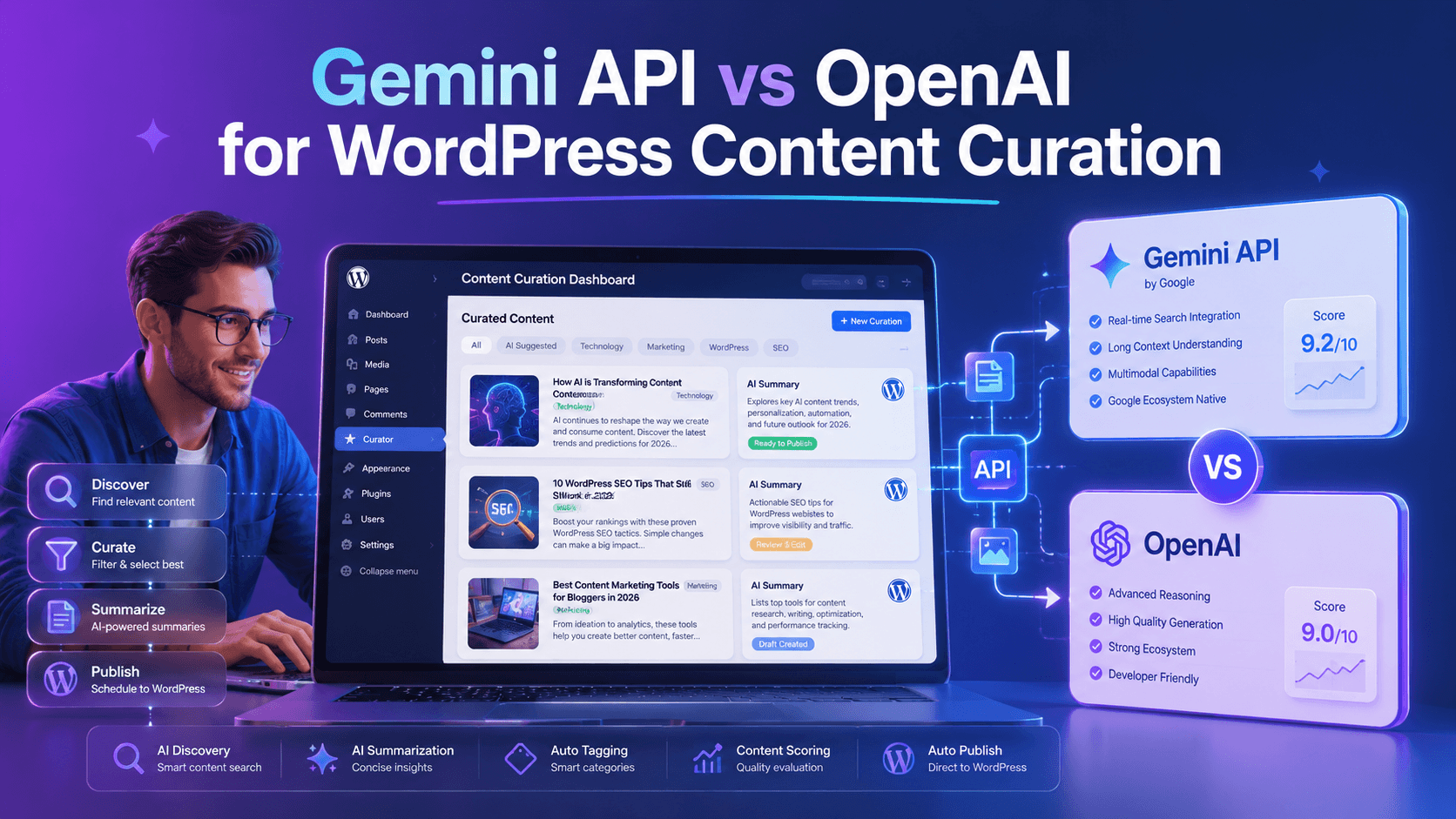
For WordPress content pipelines, Gemini is the “Value & Velocity” king—ideal for high-volume ingestion and low-cost scaling. OpenAI remains the “Editorial Gold Standard”—preferred for precise formatting and strict adherence to brand voice. In 2026, Gemini 3 Flash undercuts GPT-5.4 mini on price per token, while benchmarks from Artificial Analysis show it leading in raw speed. Choose Gemini for bulk draft generation; choose OpenAI for boutique, high-precision rewrites.
Stop viewing LLMs as chatbots and start viewing them as production components. In a professional WordPress operation, “pretty answers” don’t matter—unit economics and output stability do.
When you integrate an AI into a publishing pipeline, you are hiring a digital editor. You need to know if that editor is fast enough to keep the queue moving and cheap enough to protect your margins. This is the real landscape of Gemini API vs OpenAI.
Defining modern WordPress curation
In 2026, WordPress content curation isn’t just summarizing an article. It is an automated sequence: ingesting raw data, extracting “signal,” and using the WordPress REST API to build a structured draft. We are talking about auto-generating SEO slugs, excerpts, tags, and formatted HTML blocks without a human ever touching a “Copy” button.
The Strategic Choice
| If you need… | The Winner | The Reason |
|---|---|---|
| Bulk processing of thousands of sources | Gemini | Superior token economics and faster “Time to First Token.” |
| Strict adherence to complex CSS/HTML schemas | OpenAI | Historically better at following “don’t do this” formatting rules. |
| Massive batch processing (Overnight) | Gemini | Aggressive batch pricing makes large-scale curation viable. |
| Direct integration with Google Search data | Gemini | Deeply integrated “grounding” tools for factual verification. |
The verdict? If your goal is to dominate volume with a “Drafts First” pipeline, Gemini is the clear winner. If you are producing fewer, high-stakes articles where a single formatting error ruins the design, OpenAI is still the safer bet.
Economics: The Race to Zero
In content operations, tokens are raw materials. According to current Gemini API pricing, Gemini 3 Flash costs $0.50 per 1M input tokens. OpenAI’s GPT-5.4 mini sits at $0.75 per 1M input tokens. For output, Gemini’s $3.00/1M competes against OpenAI’s $4.50/1M.
| Model | Input (per 1k) | Output (per 1k) |
|---|---|---|
| Gemini 3 Flash | $0.0005 | $0.0030 |
| GPT-5.4 mini | $0.00075 | $0.0045 |
On a single draft, the difference is fractions of a cent. Across a 5,000-article-per-month curation site? You are looking at a 33% reduction in your primary COGS just by switching API endpoints. For a business, that isn’t just “saving money”—it’s increasing the valuation of the entire asset.
Speed Benchmarks (Latency)
Latency is the silent killer of automated workflows. Artificial Analysis data highlights the gap: Gemini 3 Flash maintains a blistering 160 tokens per second, while GPT-5.4 mini averages around 154 tokens per second.
| Metric | Gemini 3 Flash | GPT-5.4 mini |
|---|---|---|
| Output Speed | 160 t/s | 154 t/s |
| First Chunk Latency | 7.68s | 10.82s |
| Total Response Time | 10.80s | 14.06s |
If you’re running a real-time curation feed where news needs to hit WordPress drafts the moment it breaks, those 4 seconds of “thinking” time in GPT-5.4 mini can cause a massive bottleneck in your Node.js or Python worker queues.
Operational Reality: Output Quality
Quantity has a quality all its own, but quality has a cost all its own. For WordPress, you need Schema Obedience. If the model returns malformed JSON, your REST API call fails. If the model adds “Here is your article:” before the HTML, your draft is ruined.
Gemini is an eager synthesizer; it moves fast and iterates quickly. OpenAI remains the “disciplined” model—it is generally better at strictly adhering to negative constraints (e.g., “Never use the word ‘delve’ or include Markdown code fences”).
Automation Snippet: Gemini to WP-REST
This is how you turn a model into a content worker. This Node.js snippet generates a draft and pushes it via the REST API—no clunky plugins required.
import { GoogleGenAI } from "@google/genai";
const ai = new GoogleGenAI({ apiKey: process.env.GEMINI_API_KEY });

async function generateWPDraft(sourceText) {
  const prompt = `Return JSON only: {title, slug, excerpt, content}. Use WordPress-ready HTML. Source: ${sourceText}`;

  const result = await ai.models.generateContent({
    model: "gemini-3-flash",
    contents: prompt,
    config: { responseMimeType: "application/json" }
  });

  const draft = JSON.parse(result.text);

  // Post to WordPress REST API
  const res = await fetch(`${process.env.WP_URL}/wp-json/wp/v2/posts`, {
    method: 'POST',
    headers: { 'Authorization': `Basic ${process.env.WP_AUTH}`, 'Content-Type': 'application/json' },
    body: JSON.stringify({ ...draft, status: 'draft' })
  });
  return res.json();
}
Expert Truths (What the Docs Hide)
1. Cost per Usable Draft is the only metric
A $0.01 draft that requires 5 minutes of human editing is actually a $5.00 draft. Always calculate the “human-in-the-loop” cost when comparing Gemini and OpenAI.
2. Fast garbage is still garbage
Gemini’s speed is incredible, but if your prompt isn’t engineered carefully, it will produce content that feels “thin.” OpenAI often provides more “meat” on the first pass with a well-structured system prompt.
3. Draft-first or Die
Never automate straight to “Published.” AI synthesis can drift into hallucination territory. Every API-driven workflow must land in the draft bucket for manual verification before anything goes live.
Pro-Tip
Use Gemini for the “heavy lifting” (summarizing 10 source articles into one data set) and then a smaller, cheaper OpenAI call to “polish” that data into your specific brand voice. This gives you Gemini’s economics and OpenAI’s editorial finesse.
The Bottom Line
In the Gemini API vs OpenAI war, stop looking for a winner and start looking for a workflow. If you are building a volume-heavy curation engine, Gemini 3 Flash is your best friend. If you are building a high-end, voice-sensitive news desk, OpenAI is your best editor.
The most dangerous thing you can do in 2026 isn’t picking the “wrong” model—it’s having no system at all. If you are still copy-pasting between ChatGPT and WordPress, you aren’t an operator; you’re an employee of your own blog.
FAQ: Gemini API vs OpenAI for WordPress
Is Gemini API cheaper than OpenAI for WordPress content pipelines?
Yes, significantly. Gemini 3 Flash costs $0.50 per 1M input tokens and $3.00 per 1M output tokens. GPT-5.4 mini is $0.75 input and $4.50 output. On a single draft the gap is negligible, but at 5,000 articles per month that is a 33% reduction in your primary cost of goods. If you are running any kind of real volume, the switch pays for itself immediately.
Which is faster for bulk WordPress content: Gemini Flash or GPT-5.4 mini?
Gemini 3 Flash. It delivers the first chunk in 7.68 seconds versus 10.82 seconds for GPT-5.4 mini, and outputs 160 tokens per second versus 154. In a single API call the difference is imperceptible. In a worker queue processing hundreds of articles overnight, that latency gap compounds into a bottleneck that will blow your scheduled windows.
Can I use Gemini API to automatically post to WordPress?
Yes. Set responseMimeType: "application/json" in Gemini’s generation config, prompt it to return {title, slug, excerpt, content}, then POST the result to /wp-json/wp/v2/posts with Basic Auth headers. The Node.js snippet in this post shows exactly how. Always post with status: "draft" first—never automate straight to published.
Should I use OpenAI or Gemini for WordPress autoblogging in 2026?
Use both in a multi-model pipeline. Gemini for ingestion and bulk synthesis (it is cheaper and faster), OpenAI for the final polish pass (it follows formatting rules and brand voice constraints more reliably). Treating them as competitors is the wrong frame. Treating them as specialist workers with different strengths is how you build a curation machine that actually ships clean copy.
What is the biggest mistake when automating WordPress content with AI?
Publishing without a review gate. Every AI pipeline should land in draft status first. AI hallucinations, HTML formatting failures, and brand voice drift are all real and all fixable—but only if a human sees the draft before it goes live. Build a 30-second review step into the workflow or you will spend far more time cleaning up indexing damage and reader trust issues down the road.
{
“@context”: “https://schema.org”,
“@type”: “FAQPage”,
“mainEntity”: [
{
“@type”: “Question”,
“name”: “Is Gemini API cheaper than OpenAI for WordPress content pipelines?”,
“acceptedAnswer”: {
“@type”: “Answer”,
“text”: “Yes. Gemini 3 Flash costs $0.50 per 1M input tokens and $3.00 per 1M output tokens. GPT-5.4 mini is $0.75 input and $4.50 output. At 5,000 articles per month that is a 33% reduction in primary cost of goods.”
}
},
{
“@type”: “Question”,
“name”: “Which is faster for bulk WordPress content: Gemini Flash or GPT-5.4 mini?”,
“acceptedAnswer”: {
“@type”: “Answer”,
“text”: “Gemini 3 Flash. First chunk in 7.68s vs 10.82s, and 160 tokens/second vs 154. In a worker queue processing hundreds of articles, that latency gap compounds into a serious bottleneck.”
}
},
{
“@type”: “Question”,
“name”: “Can I use Gemini API to automatically post to WordPress?”,
“acceptedAnswer”: {
“@type”: “Answer”,
“text”: “Yes. Use responseMimeType: ‘application/json’ in Gemini’s config, prompt for {title, slug, excerpt, content}, then POST to /wp-json/wp/v2/posts with Basic Auth. Always post as draft status first, never automate straight to published.”
}
},
{
“@type”: “Question”,
“name”: “Should I use OpenAI or Gemini for WordPress autoblogging in 2026?”,
“acceptedAnswer”: {
“@type”: “Answer”,
“text”: “Use both. Gemini for bulk ingestion and synthesis (cheaper and faster), OpenAI for the final polish pass (better at following strict formatting and brand voice rules). A multi-model pipeline gives you the economics of Gemini and the precision of OpenAI.”
}
},
{
“@type”: “Question”,
“name”: “What is the biggest mistake when automating WordPress content with AI?”,
“acceptedAnswer”: {
“@type”: “Answer”,
“text”: “Publishing without a review gate. Every AI pipeline should land in draft status first. Hallucinations, HTML formatting failures, and brand voice drift are all fixable — but only if a human sees the post before it goes live.”
}
}
]
}