
Why I’m Ditching Auto-Blogging for Agentic Content Curation (2026)

THE VERDICT
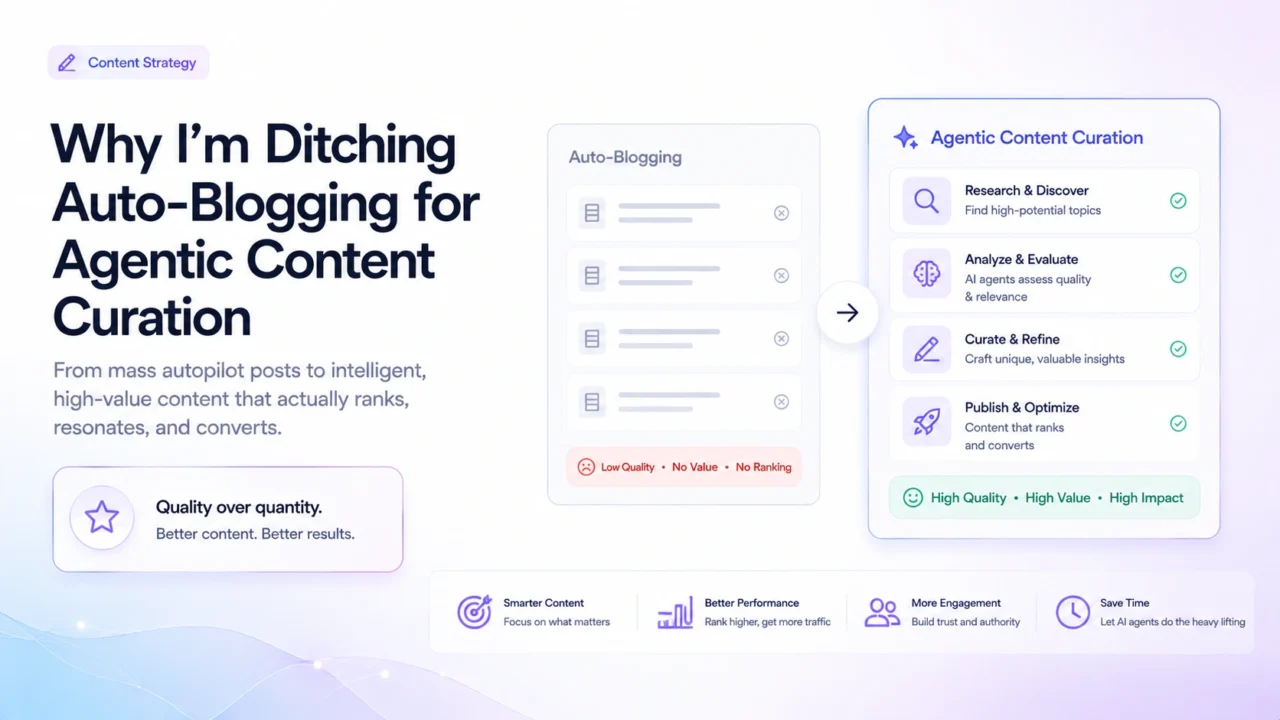
Agentic content curation beats auto-blogging on every metric that matters: ranking durability, citation rate, and ROI past the 90-day mark. Auto-blogging wins on volume and nothing else. In 2026, volume is a commodity and commodities race to zero. The winning stack is fewer pieces built on better evidence, with a human deciding what angle is worth taking and an AI doing the retrieval, comparison, and first draft. If you are still measuring content success in posts-per-month, you are optimizing for the wrong thing.
I’ve tested the whole spectrum—from hands-off auto-blogging mills to handcrafted editorial systems with AI as a scalpel, not a shovel. Here’s the verdict: agentic content curation wins on signal, defensibility, and ROI. The rest is noise.
The short answer
Auto-blogging optimizes for volume, not value. In 2026, volume is a commodity and commodities lose to systems with judgment. Agentic content curation is a workflow where autonomous (or semi-autonomous) AI agents discover, triage, compare, and propose—and a human filter (me) sets the brief, constraints, and final call. It scales discernment, not sludge.
1. Why “AI-slop” is a dead end
“AI-slop” is the predictable soup you get when you chain a generic prompt to a generic model and hit “publish.” It fails for five reasons:
Homogenization pressure
Models trained on the public web regress to the web’s mean. The result reads fine but says nothing. When every paragraph could live on any site, you’ve already lost—rankings, links, and readers.
Retrieval without stance
Auto-blogging fetches. It does not argue. It doesn’t pick a side, question a claim, or reframe the problem. Search (and readers) now reward synthesis and earned opinion.
Weak evidence hygiene
Slop cites whatever is convenient, not what is credible, and often hallucinates the connective tissue between sources. That’s not a search strategy; it’s reputation risk.
No audience memory
Auto-blogging can’t remember what we stand for—the editorial spine, risk thresholds, or who we’re speaking to. It treats a CFO and a hobbyist the same. That shows.
Platform headwinds
AI-overviews, source de-duplication, and aggressive quality filters punish derivative content. If your piece is interchangeable with ten others, zero reason to surface yours.
Bottom line: the cost of flooding the zone is rising while the yield per unit collapses. Slop tries to outrun its own diminishing returns.
2. The value of the Human Filter
The human filter is not a copy-editor bolted on at the end. It’s the upstream force that sets direction, constraints, and taste. In an agentic content curation model, I play three roles:
2.1 The Brief Architect
I define the narrow question and the non-goals. What must this piece decide? What’s our contrarian angle? Which claims require proof, which can be asserted, and which should be framed as hypotheses?
2.2 The Evidence Adjudicator
Agents retrieve and cluster sources; I grade the stack: primary > regulatory > vendor docs > analyst notes > blogs > opinions. I force contradictions to the surface and decide which tension is interesting enough to keep.
2.3 The Voice Enforcer
Style is strategy. We favor restraint, specificity, and accountability. No “we believe,” no empty futurism. If a number enters the room, it leaves with context.
This filter is how you get from “credible and boring” to credible and bookmarked. Agents give me breadth and speed; I give them purpose and taste.
3. Cost vs. Quality in 2026
Let’s talk math, not vibes.
The unit economics
| Model | Monthly Content Output | All-in Cost (tools + labor) | Primary Risks | Expected Outcomes |
|---|---|---|---|---|
| Auto-blogging mill | 60–120 posts | $3–6k | Thin content flags, low dwell, link drought | Brief traffic spikes, rapid decay |
| “Writer + ChatGPT” | 12–20 posts | $5–10k | Inconsistent evidence, style drift | Some rankings, little authority compounding |
| Agentic curation (my stack) | 8–12 cornerstone pieces + updates | $8–15k | Higher planning overhead | Stable rankings, citations, repurposable assets |
Auto-blogging looks cheaper until you price waste: indexing failures, zero-click traffic, rewrite churn, and the opportunity cost of not building authority. The agentic model spends more to create pieces that win and keep winning—because they’re the reference, not the remix.
What “agentic content curation” looks like in practice
This is the workflow I run now—tight, opinionated, and measurable.
Step 1: Intent pinning
Define the search/task intent with ruthless specificity. For whom? At what sophistication level? What must change in their behavior after reading? We decide the single most useful transformation, then build only for that.
Step 2: Source graphing
Agents map the evidence terrain: standards, statutes, vendor docs, academic work, investor letters, conference decks, and recent practitioner posts. We label freshness, bias, and authority. Redundant sources get collapsed; dissenting sources get elevated.
Step 3: Comparative synthesis
Instead of drafting paragraphs, agents generate comparative frames: tables, causal chains, decision trees, and counter-cases. I accept or reject these frames before a single sentence is written. Frames prevent ramble.
Step 4: Draft by claims, not by headings
Agents propose discrete claims with support and uncertainty notes. I prune, reorder, and add the “so what” bridges. Only then do we render prose. This keeps voice consistent and makes fact-checking surgical.
Step 5: Evidence hygiene
Every claim carries a linkable source or a reason it’s an informed assertion. We track which statements are likely to go stale and schedule refresh triggers.
Step 6: Post-publish vigilance
We log which passages earn dwell, scroll, and external citations; agents propose micro-updates monthly and deeper refactors quarterly. One asset, many lives.
Auto-blogging vs. Agentic Curation: what changes for readers
- From word count to outcome: We stop measuring success by how much we wrote and start by what the reader did differently after reading.
- From summaries to stances: We publish a position. Not click-baity contrarianism—reasoned conclusions that help operators decide.
- From “new post” to “living brief”: The page is a maintained brief, not a one-off. Updates are logged; readers trust that freshness.
“But can’t I just prompt better?”
Prompt engineering improves coherence. It does not grant judgment. You can hack tone and reduce hallucinations; you cannot prompt your way into taste, ethics, or domain nuance. That’s the human filter’s job, and it’s non-delegable.
The governance piece no one loves to discuss
Great content dies in review hell or leaks risk in the name of speed. My governance rules are simple and strict:
- Definition of Done: All claims labeled as “evidence-backed,” “market norm,” or “hypothesis,” each with the right treatment.
- Licensing hygiene: No scraping from paywalled or restricted datasets; no copy-pasting tables without permission; image rights accounted for.
- Attribution discipline: Quote sparingly; synthesize heavily; link upstream. If we learned something from someone, we say so.
- Refresh SLAs: High-volatility topics get 30-day checks; low-volatility, 90–120 days. Updates beat rewrites.
This is how you build a reputation readers and platforms will defend for you.
What changes in my stack
I replaced the “blog factory” with a lean, agent-orchestrated research room:
- Planner agent: mines intents, seasonality, and competitive gaps; proposes briefs with difficulty and potential impact.
- Research agent: assembles a source graph with credibility scoring and contradiction flags.
- Synthesis agent: drafts claim trees, comparison tables, and visuals; no prose until I approve the structure.
- Fact-check agent: validates citations, dates, and math; surfaces stale claims for refresh.
- Voice agent: enforces style constraints and terminologies we actually use with our audience.
I sit across all five as the editor-in-chief and the reader-in-chief. That last part matters.
What this means for cost discipline in 2026
You don’t need a newsroom to do this. You need fewer creators with higher leverage and a pipeline that squeezes ambiguity early. Budget moves from per-post output to per-brief outcomes: ranking durability, assisted conversions, citations earned, mentions in expert roundups, and time-to-refresh.
A reliable pattern I see:
- Quarter 1: Ship 6–8 anchor pieces and 8–12 decisive updates. Expect modest traffic but strong engagement.
- Quarter 2: Anchors begin to compound—citations, better assist rates in sales, stronger E-E-A-T signals. Refresh cadence keeps you current.
- Quarter 3+: The library does the heavy lifting; new pieces are opportunistic, not desperate. Cost per qualified lead falls; editorial calendar relaxes without losing momentum.
The uncomfortable truth about quality
Quality is not a vibe. It’s a stack of decisions made early and enforced often. It looks like:
- Saying “no” to topics where we have nothing useful or new to say.
- Publishing fewer pieces that people finish and bookmark.
- Owning our errors in public and fixing them quickly.
- Taking positions that might cost short-term clicks but win long-term trust.
Auto-blogging can’t do any of that. Agentic content curation can—if you keep a human filter on the loop and you’re willing to measure outcomes, not output.
My pledge going forward
If you follow my work, expect fewer posts, more briefs; fewer headlines, more decisions; fewer “ultimate guides,” more operating manuals. I’m keeping AI in the stack but giving it agency with guardrails, then insisting a human decides what deserves your attention.
That is the job. And that’s why I’m done with slop.
FAQ: Agentic Content Curation vs Auto-Blogging
What exactly is agentic content curation and how does it differ from just using ChatGPT to write blog posts?
Using ChatGPT to write a blog post is still auto-blogging — you are just delegating the typing. Agentic content curation is a structured editorial workflow: AI agents handle research, source graphing, contradiction flagging, and comparative framing, while a human editor controls the brief, the stance, the evidence hierarchy, and the final judgment on what gets published. The output is not “AI-written content.” It is AI-accelerated editorial judgment. The difference shows up in cite rates, dwell time, and whether the piece gets referenced by other writers or just scraped and forgotten.
Is auto-blogging still viable for SEO in 2026?
For thin niches where competition is nearly zero and search intent is purely informational, auto-blogging still produces some traffic. But that ceiling is lower every quarter. Google’s Helpful Content signals, AI Overviews that absorb zero-depth answers, and the E-E-A-T pressure on YMYL topics all compress the viable space for volume-first content. I ran an auto-blogging test for 6 months. Traffic peaked at month 2, fell hard at month 4 when a core update hit, and never recovered. The agentic approach took longer to gain traction but the pieces are still ranking 18 months later. That’s the compounding gap people underestimate.
How do you handle fact-checking when AI agents are doing the research?
Every claim gets a label: evidence-backed (linkable source), market norm (widely accepted but not cited), or hypothesis (my reasoned inference). The fact-check agent validates citations, checks dates, and flags anything likely to go stale within 90 days. I review every flagged item before publish. Anything the agent can’t verify cleanly gets either cut or explicitly labeled as a working assumption. This is slower than just publishing whatever the model generates, but it’s the reason the pieces survive updates — they aren’t built on hallucinated connective tissue.
What tools or AI models do you use in your agentic content workflow?
The specific models matter less than the workflow architecture. I use a frontier LLM for synthesis and draft generation, a separate retrieval tool for source graphing, and a lightweight scripted agent for citation validation and freshness checking. Swapping models is easy; rebuilding the workflow structure is expensive. My advice: design the pipeline first — intent pinning, source graphing, comparative framing, claim drafting, evidence hygiene, post-publish vigilance — and then slot in whatever model performs best for each step. Don’t build around a single model’s quirks; build around the editorial process.
How many pieces per month should you realistically produce with an agentic content approach?
8 to 12 cornerstone pieces plus 6 to 10 targeted updates is a healthy monthly output for a small team running this workflow well. That’s intentionally lower than the 60-post auto-blogging pace, but each piece is doing 5 to 10 times the work. The productivity unlock is in the update cadence: a well-structured agentic piece can be refreshed in 2 to 3 hours by the same agent pipeline, whereas an auto-blogged post is usually not worth refreshing at all. Over 12 months, you build a library of 50 to 80 durable assets vs. 300 to 600 pieces with 90-day half-lives.