
What Digital Marketing Services Actually Do (And Which Ones Are Worth Your Budget)

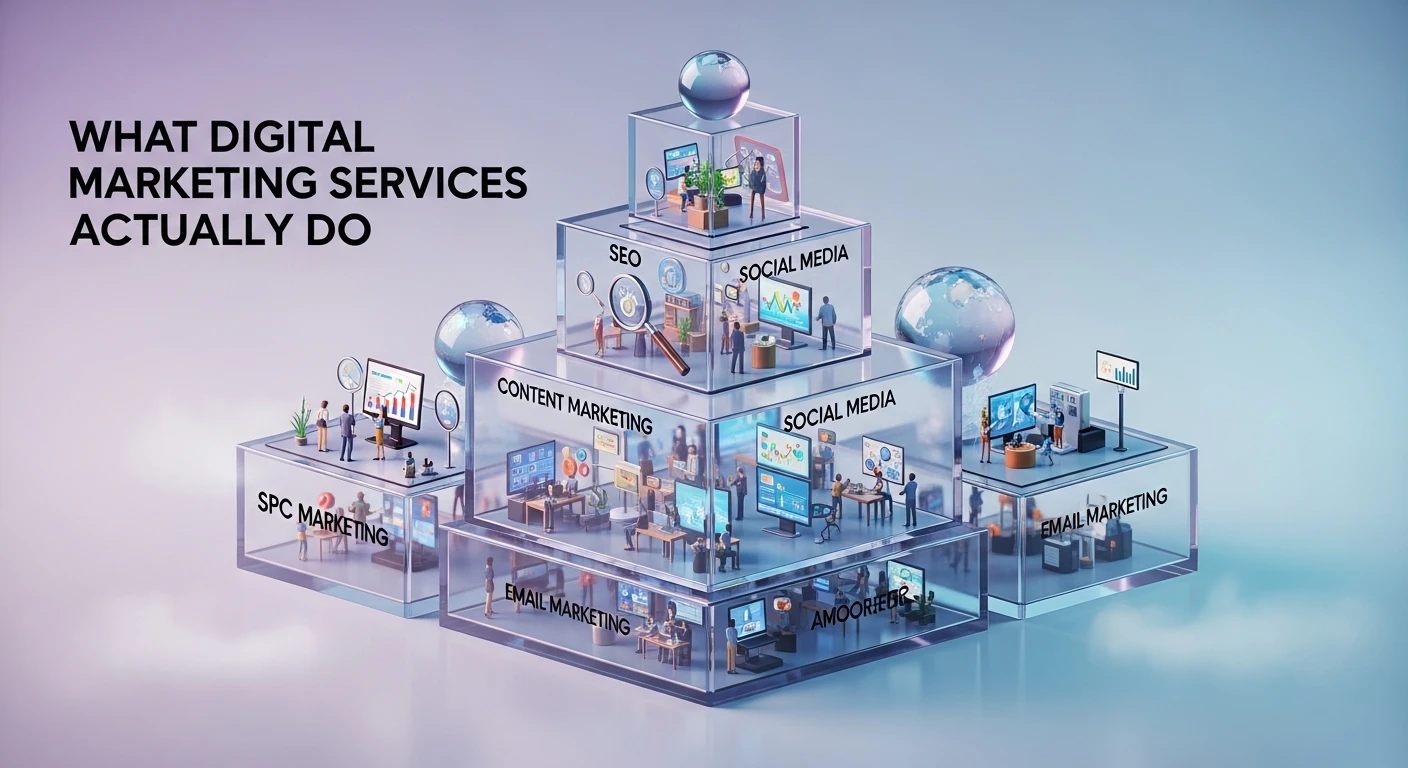
Most small business owners come to digital marketing after something breaks. The phone stops ringing, a competitor shows up above them in search, or they run a few Google Ads and get nothing back. At that point, “digital marketing” goes from a vague concept to a fairly urgent question.
The honest answer is that it’s not one thing. It’s a collection of services that work best when they’re coordinated — and understanding what each piece does helps you figure out what you actually need, and what you can probably skip for now.
Search Engine Optimization
SEO is the slowest of the major channels, which is why a lot of businesses underestimate it. It typically takes three to six months before organic rankings move in any meaningful way, and longer if the site has technical issues or a thin backlink profile.
What it actually involves: fixing the technical foundation of your site (crawlability, page speed, schema markup), building out content that matches what your customers are searching for, and earning links from other credible sites. None of these are one-time tasks. Rankings move, competitors publish new content, search algorithms update. Ongoing SEO is maintenance work as much as it is growth work.
For local businesses, the math is a bit different. A dentist in Boise doesn’t need to outrank Healthline — they need to show up when someone searches “dentist near me” or “teeth whitening Boise.” Local SEO work focuses on Google Business Profile, location-specific landing pages, and citations across local directories. Agencies that specialize in a market tend to be more useful here than generalists. SEO marketing boise is a good example — Bear Fox Marketing works with local and regional businesses specifically on the kind of visibility that drives foot traffic and local leads, not just abstract keyword rankings.
Pay-Per-Click and Google Ads Management
If SEO is slow and compounding, paid search is fast and linear. Stop paying, stop showing up. That’s the main trade-off.
Google Ads can work well when your margins support the cost per acquisition, your offer is clear, and someone is actually managing the campaigns. That last part gets skipped more than it should. Automated bidding strategies and broad match keywords can burn a budget quickly if nobody’s watching the search term reports.
What good Google Ads management looks like: regular negative keyword additions, bid adjustments by device and time of day, landing pages that match ad copy, and conversion tracking that actually measures something meaningful (not just page visits). A campaign that generates qualified leads at a sustainable cost takes a few months of iteration to dial in. Anyone promising instant results is usually overpromising.
Bear Fox handles Google Ads management as part of their broader service set, which matters because paid and organic strategy work better when the same team can see both. If your SEO is pulling traffic for one set of keywords, you don’t necessarily need to bid on those — you can allocate budget to terms where you don’t yet rank.
Web Development and Conversion
Traffic without a functional website is just an expensive way to generate bounces. This is where web development overlaps with marketing in ways that aren’t always obvious.
A site can rank well and still convert poorly. Common reasons: slow load times (especially on mobile), unclear calls to action, contact forms that don’t work, or page layouts that bury the most important information. A developer who understands both the technical side and the marketing side can usually spot these faster than someone who only knows one or the other.
Bear Fox includes web development in their service offering, which means they can work on the site itself — not just advise on what should change. For small businesses that don’t have an in-house dev, that kind of integrated support makes a real difference. You’re not managing two separate vendors with different incentives.
Strategy and Performance Analytics
This is the part that gets cut first when budgets tighten, which is somewhat backwards. Without a clear strategy, individual services tend to operate in isolation. Without analytics, you can’t tell what’s working.
Strategy at the practical level means: deciding which channels to prioritize based on your business model, setting realistic targets, and building a plan that accounts for your current baseline. For a new site with no domain authority, doubling down on paid search makes more sense in the short term than waiting on organic results. For an established local business with decent rankings, the priority might be conversion rate optimization on existing traffic rather than new channel acquisition.
Performance analytics means connecting your marketing activity to actual business outcomes — not just impressions and clicks, but leads, calls, sales. Google Analytics 4 is the standard starting point, but it requires proper configuration to be useful. Unconfigured, it tells you how much traffic you’re getting. Configured properly, it tells you where your best customers come from and what they did before converting.
Bear Fox’s approach to strategy and analytics is essentially what differentiates them from commodity services. The work isn’t just executing individual tactics — it’s understanding what the business is trying to achieve and building a measurement framework that can tell you whether you’re getting there.
How to Think About Choosing Services
Not every business needs everything at once. A rough prioritization that tends to work: make sure your site is functional and converting before investing heavily in traffic. Get your Google Business Profile and local SEO in order if you have a physical location or a service area. Then layer in paid search or content marketing based on what your margins and timeline support.
The agencies worth working with are usually the ones that ask about your business before they quote you. If a proposal skips straight to deliverables without understanding your current position, that’s a signal worth paying attention to.
Digital marketing works best as a compounding system — each channel reinforcing the others over time. That takes patience and coordination, but the businesses that treat it that way tend to outgrow the ones that just buy traffic.
If you’re a small or mid-sized business evaluating options, it’s worth talking to a few specialists before committing. The right mix depends heavily on your market, your margins, and how quickly you need results.