How to Use Ahrefs and AI to Plan WordPress Posts
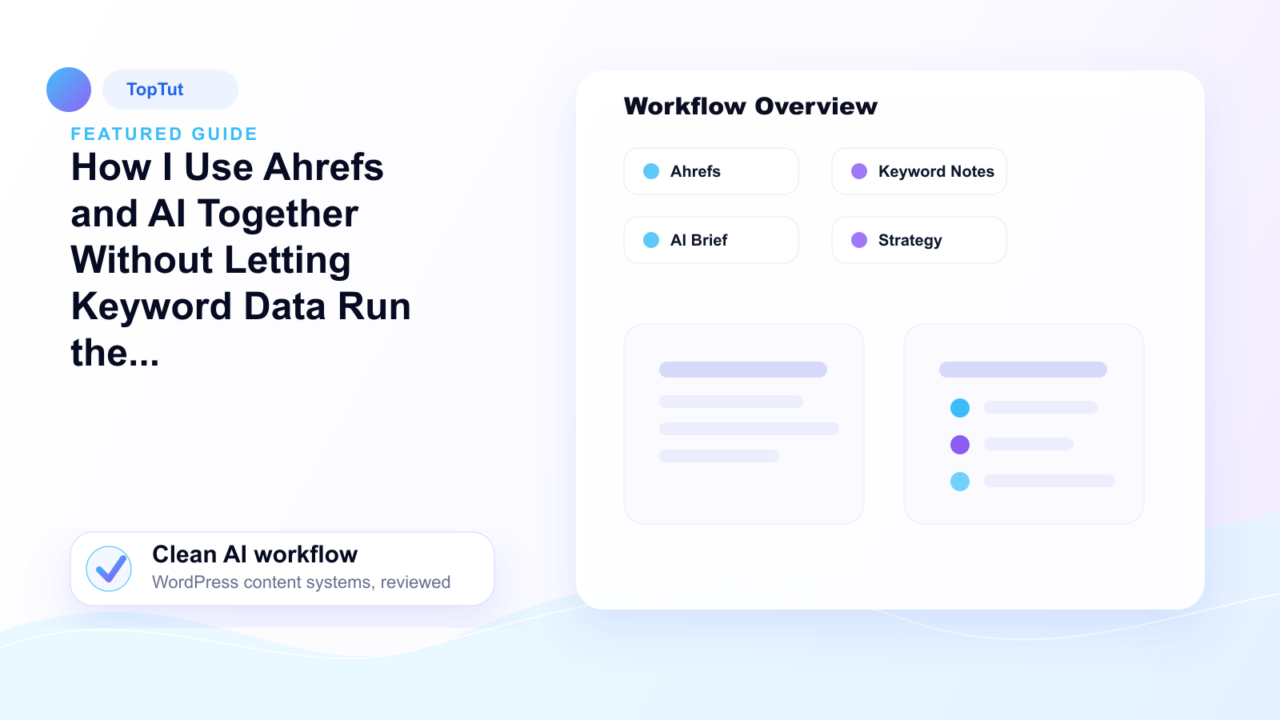
Use Ahrefs estimates to find candidate questions, then use AI to group notes by reader task. Decide whether to update, create, or skip.

Keyword research can reveal a question worth answering. It cannot supply the experience, product check or example that makes the answer credible. A high-volume phrase can lead to a weak post if it asks for a buying verdict while the site only has a tutorial. Start with the reader task and the pages TopTut already has.
Read the metrics as clues
Ahrefs says its search volume is an estimate, and a search does not necessarily become a click. Its Keyword Difficulty metric estimates first-page competition from referring domains; it does not account for on-page quality. Neither figure says whether TopTut should publish the topic or can satisfy the searcher.
Open the current search results for a candidate query. Are the leading pages tutorials, product pages, forum answers or comparisons? Note what the reader must decide and which facts are time-sensitive. Then inspect existing TopTut posts for overlap. If an old page already answers the question, a focused revision may be more useful than a second page with a near-identical title.
Make a small source-bound keyword note
Consider a hypothetical note set: “WordPress image alt text,” “AI alt text generator,” and “decorative image alt attribute.” These phrases sound related, but they imply different jobs. One reader needs a WordPress field, another wants to evaluate an AI tool, and a third needs an accessibility decision. Do not merge them into one heading list just because the words overlap. The example does not assert search volume or current rankings.
TopTut already has an image-alt-text guide. A useful follow-up brief would first ask which reader question that page leaves unanswered. W3C’s image tutorial can support a distinction between informative and decorative images. It cannot establish that a specific AI generator is accurate or worth buying. That would need a separate product test and current documentation.
Give AI the notes, not invented demand
A bounded request is: “Group these phrases by reader task. For each group, state whether the existing article answers it, needs a revision, or leaves a separate question. Use only the supplied notes and URLs. Do not invent traffic, difficulty, search intent or a product verdict. Quote the passage that makes you recommend an update.” Review the output against the live pages and search results.
The output should produce an editorial decision, not a stack of synonym headings. A proposed section stays only when it answers a real step or objection. If an idea requires facts TopTut cannot verify, keep it in research. If a query is just another way to ask the same question, use the natural phrasing in the existing article.
Decide whether to update, create or skip
- Update: A relevant post exists but lacks a verified step, current screenshot, or clear answer to the reader’s question.
- Create: The task is distinct, TopTut can add a sourced example or test, and the proposed page will not duplicate an existing guide.
- Skip: The search result calls for a claim, product experience or comparison the site cannot presently support.
Before a new WordPress post goes live, check its title, opening, sources, internal links and rendered public page. Google’s people-first content guidance asks whether visitors can achieve a goal and whether a page adds value beyond restating other sources. A keyword estimate can start the research; the finished reader outcome decides whether the post belongs on the site.